A tree can look sound one day and become a serious hazard overnight. High winds, saturated ground, snow loading and falling limbs can leave a tree hanging over a roof, blocking a driveway or leaning towards power lines. When that happens, emergency tree removal Canterbury property owners need is not simply about getting a chainsaw on site quickly. It is about making the area safe, assessing what has failed and removing the risk without creating a bigger one.
For homeowners, managers and landholders, the first few decisions matter. Keeping people clear of the danger zone and calling a qualified arborist early can protect people, buildings, vehicles and neighbouring properties.
What counts as a tree emergency?
Not every fallen branch requires an urgent callout, but a damaged tree should be treated as an emergency when there is a credible risk of injury, property damage or loss of access. A mature limb suspended over a house, a trunk split near its base, or a tree uprooting in wet ground can all deteriorate quickly as wind continues or timber shifts under its own weight.
Common emergency situations include a tree or large branch on a home, shed, fence, vehicle, accessway or public footpath. Trees that have fallen or are tangled in power lines require immediate caution. So do trees that are leaning suddenly, have exposed roots and lifted soil at the base, or have a split stem with one section still standing.
A blocked commercial entrance, farm track or shared driveway can also warrant a rapid response. The level of urgency depends on whether people can safely avoid the area and whether there is a realistic chance of further movement. A branch lying safely on open lawn may be able to wait for scheduled removal. A branch hanging above a child’s bedroom should not.
First actions after storm damage
The safest response is usually the least hands-on one. Do not stand beneath damaged limbs, climb the tree, pull on hung-up branches or try to cut timber that is under tension. What appears stable can release suddenly, and even small branches can carry substantial force when they spring under tension or fall.
Move people, pets and vehicles away from the area where it is safe to do so. Keep well clear of any fallen or sagging electrical lines. Treat all lines as live at all times, stay away from fences or objects that may be energised, and contact the electricity network operator or emergency services if there is an immediate threat. An arborist should not begin tree work around live lines until the appropriate electrical safety controls are in place and the utility company give them the go ahead to start work.
If the tree has damaged a roof, take photos from a safe position for your insurer and avoid entering any part of the building that may be structurally compromised. Where practical, note the time of the event, weather conditions and any obvious changes in the tree’s position. These details can help with assessment and insurance documentation.
Avoid the temptation to clear access with a domestic chainsaw. Windblown timber is often compressed, twisted or supported in unpredictable ways. The cut that looks obvious from the ground can cause the log, root plate or branch to roll, jump or settle without warning.
How emergency tree removal in Canterbury is managed safely
A professional emergency response begins with an on-site hazard assessment. The Tree Technician arborist considers the tree’s species, size, decay, root condition, direction of lean, remaining attachment points and likely movement. They also assess nearby buildings, services, vehicles, roads, fences and people who may be affected by the work.
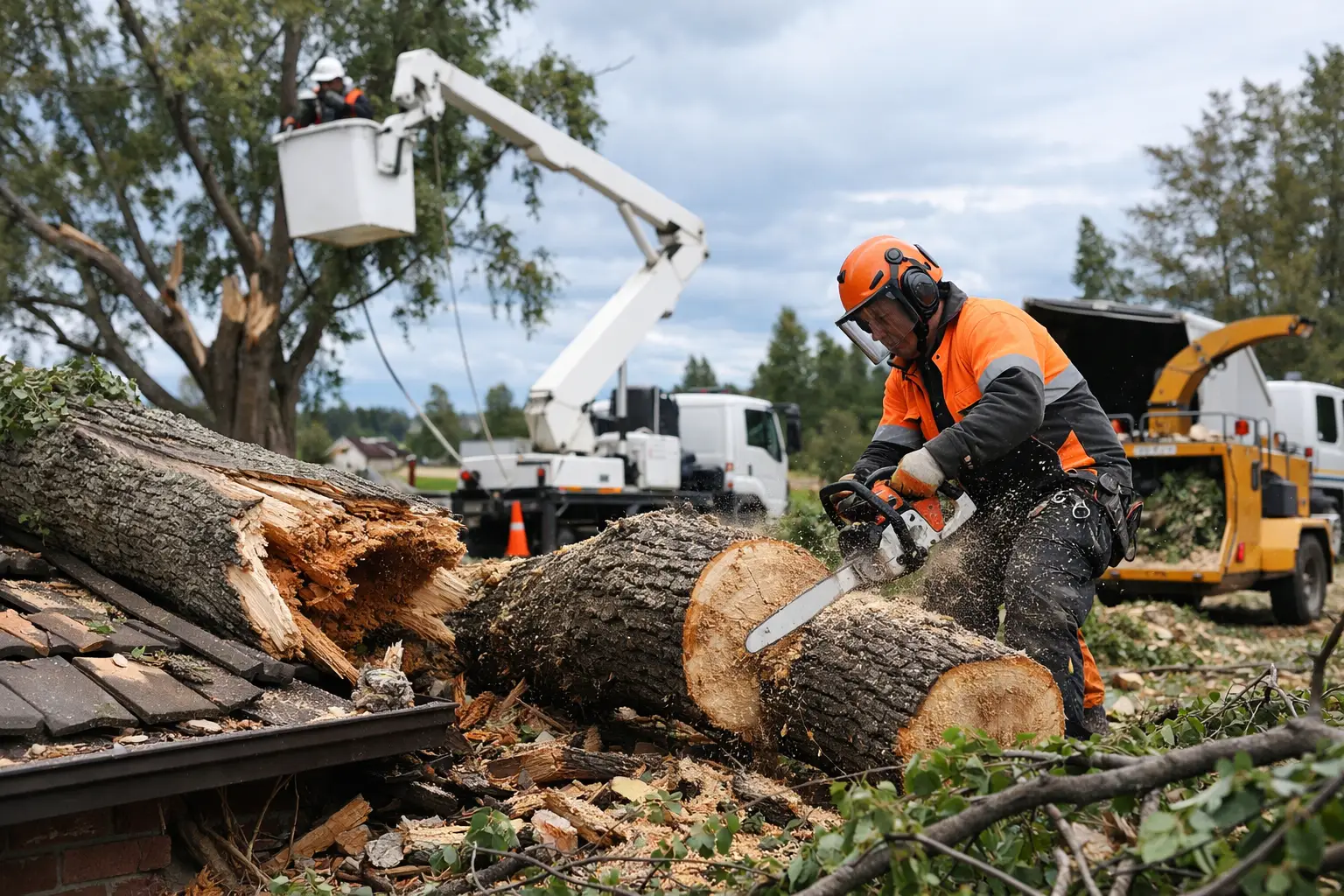
The removal method depends on the site. A small tree may be dismantled from ground level, while a large, compromised tree near a building may need to be carefully sectionalised by a climbing arborist or removed with elevated access equipment or climbing for a neighbouring tree if one is suitable. Where access allows, machinery can reduce manual handling and keep the crew out of higher-risk positions. In confined urban sections, sections may need to be lowered in a controlled manner rather than dropped.
This is why emergency work cannot be judged by how quickly a crew can start cutting. A slightly longer set-up that establishes exclusion zones, rigging, traffic control or electrical coordination is often the safer and more efficient choice. At Tree Technician Health and Safety is in our DNA because emergency conditions leave little room for assumptions.
Once the immediate hazard is removed, the site should be left orderly. That may include chipping branches, removing timber, clearing accessways and making sharp stumps or unstable debris safe. If requested, stump grinding can be arranged separately where the remaining stump affects access, rebuilding or future planting plans.
Why damaged trees can fail after the weather clears
Storm damage is not always obvious. A tree may remain standing after a strong wind but have fractured roots, a split union or internal cracking that becomes apparent days later. Waterlogged soils are particularly relevant across Canterbury after heavy rain. Roots can lose their grip in softened ground, especially where a tree has a broad canopy, shallow root system or restricted rooting space.
Look for fresh leaning, cracks in the trunk or major limbs, lifted ground around the root zone, peeling bark, sawdust-like material from splitting wood, or branches that have dropped without warning. A canopy that suddenly looks uneven can indicate a limb or stem has failed higher up.
Trees with pre-existing decay deserve careful attention after a weather event. Fungal fruiting bodies, deadwood, cavities and previous heavy pruning cuts do not automatically mean a tree needs removal, but they can change how it responds to wind loading. An arboricultural assessment separates an urgent defect from a manageable maintenance issue, helping avoid both unnecessary removal and false reassurance.
Removal is not always the only answer
Emergency removal is necessary when the tree cannot be made safe by any reasonable alternative. However, a damaged tree does not always need to come down completely. In some cases, selective reduction, removal of a failed limb, cabling and bracing, or ongoing monitoring may retain a healthy, valuable tree while reducing risk.
The right option depends on the remaining structure, the target beneath it and the tree’s long-term condition. A young tree with a damaged branch may recover well after correct pruning. A mature tree with a major split trunk over a building may have no safe retention option. A qualified arborist can explain the trade-off plainly, including whether remedial work is a short-term measure or a realistic long-term solution.
For protected trees, trees in sensitive locations or work near boundaries, there may also be council rules or consent requirements. An emergency does not remove the need for good judgement, but genuine hazard work may need to proceed promptly to protect life or property. Recording the damage and obtaining professional advice helps ensure necessary work is both defensible and appropriately managed.
What to expect from an emergency arborist
When you contact an emergency tree service, clear information helps the response team prepare. Describe the tree’s location, what has happened, whether it is touching a building or lines, and whether access is open for equipment. Photos are useful only if they can be taken without entering the danger area.
On arrival, the Tree Technician qualified crew, will assess the situation and explain the immediate plan, establish a safe work area and use maintained equipment suited to the job. They should be insured, appropriately trained and ready to manage the practical realities of a storm-damaged site, from confined residential gardens to commercial grounds and rural access tracks.
Tree Technician brings experienced arboricultural judgement to all urgent callouts across Canterbury, combining technical removal capability with a safety-led approach. The objective is straight forward: control the hazard, protect the site and leave you with a clear path forward rather than a pile of problems.
A safer next step for your property
After an emergency removal, take the opportunity to look beyond the tree that failed. Nearby trees may have been exposed to the same wind, soil conditions or hidden decay. A follow-up assessment can identify deadwood, weak branch unions, poor previous pruning or structural issues before another storm turns them into an urgent problem.
You cannot control Canterbury’s weather, but you can act early when a tree changes shape, leans unexpectedly or drops significant limbs. Keep the area clear, avoid DIY cutting and arrange experienced help. A calm, properly planned response is the best protection when a tree becomes unsafe.