A mature tree with a split trunk, a heavy limb stretching over a roof, or a weak fork above a driveway can create a difficult decision. Removing the tree may feel unnecessary, but leaving a known weakness untreated is not a sound option. Tree cabling and bracing can be a practical way to reduce the risk of structural failure while retaining a healthy, valuable tree.
It is not a cure-all, and it should never be used to disguise a serious defect. When specified and installed properly, however, a support system can help manage loading, limit movement at a weak union and give a tree a safer future alongside people, buildings and accessways.
What tree cabling and bracing are designed to do
Cabling and bracing are arboricultural support systems used to supplement a tree’s natural structure. They are commonly considered where a tree has two or more stems joined at a weak point, a long limb with a high leverage load, or a historic crack that needs careful risk management.
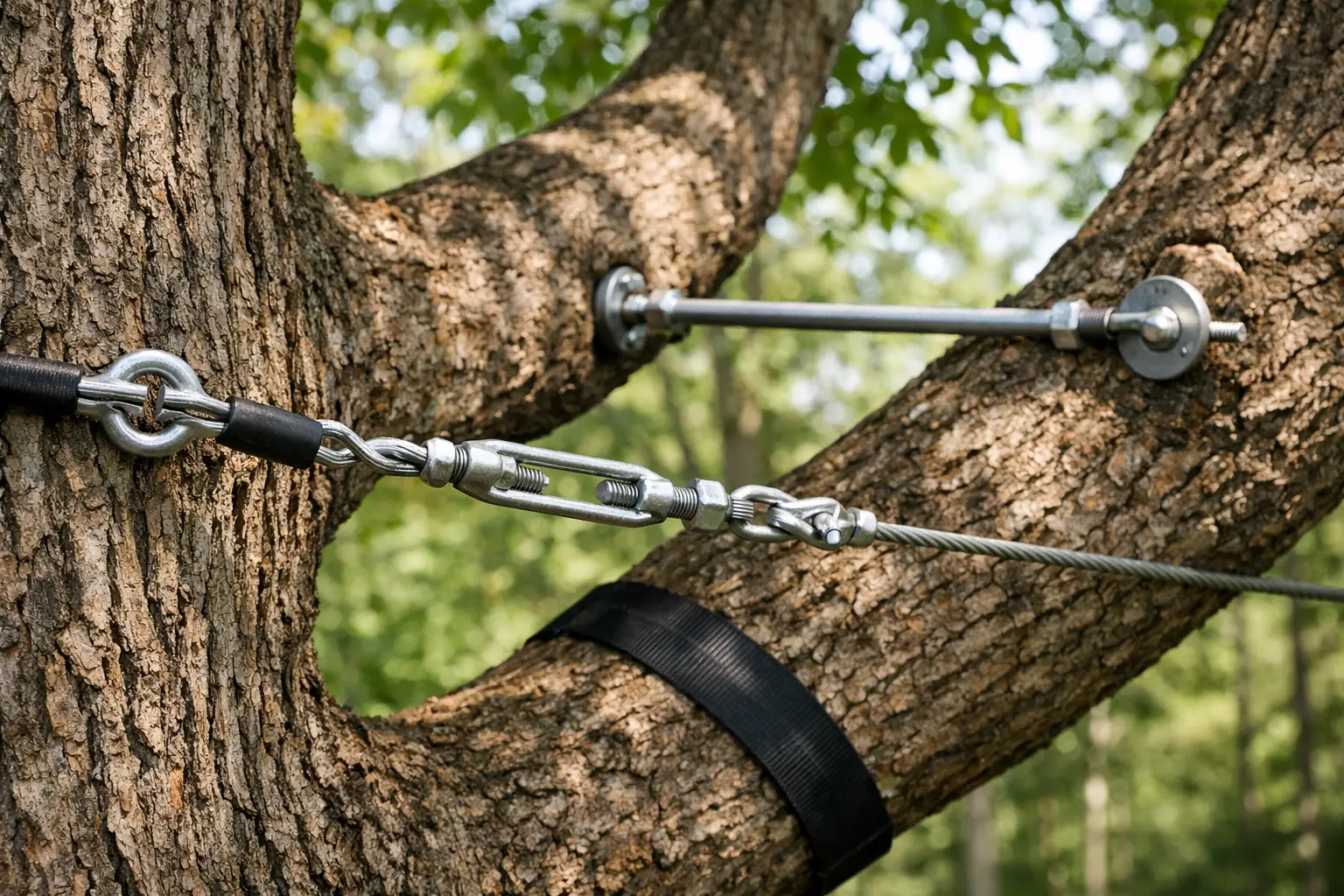
A cable is typically installed higher in the canopy between major stems or limbs. Its role is to limit how far those parts can move apart in wind, reducing the forces placed on a vulnerable union. Depending on the tree, the system may be static or dynamic. Static systems use rigid steel components to restrict movement more firmly. Dynamic systems use purpose-designed synthetic materials that allow some natural movement while helping absorb sudden loading.
Bracing generally involves rods installed through or across a weak, split or cracked section of trunk or branch. It is used where there is an identified structural separation that needs stabilising. In some cases, a tree may need both bracing lower down and cabling higher in the canopy.
The aim is not to make a tree indestructible. Trees remain living structures exposed to wind, changing soil conditions, decay organisms and seasonal growth. The aim is to lower the likelihood of a foreseeable failure and manage the risk in a measured way.
When a support system may be suitable
The right candidate is usually a tree worth retaining that is otherwise in reasonable health and has enough sound wood to support the system. Large established trees often provide shade, privacy, habitat, character and real value to a property. If their weakness can be managed, removal may not be the only answer.
Codominant stems are a common example. These are two stems of similar size growing from the same point. If the join has included bark – bark compressed between the stems rather than strong connecting wood – it can be more prone to splitting under load. A cable may reduce the chance of the stems separating during high winds.
Long horizontal limbs can also benefit from support where they extend over a house, car park, fence line or frequently used part of a site. Pruning may reduce end weight and wind resistance, while a carefully positioned cable provides additional support. Used together, these measures can be more effective than either one alone.
Cabling and bracing can also be considered after a storm event, but only once the tree has been properly inspected. A visible crack, lifted bark or sudden change in canopy position calls for urgent assessment. Do not stand beneath the affected area, attempt to pull limbs back into place, or attach ropes and hardware without professional advice. Extra force in the wrong place can turn a partial failure into a complete one.
Cases where support is not the answer
A support system is not a substitute for sound judgement. If decay has severely reduced the strength of the trunk or roots, if a crack is actively opening, or if the tree has become unstable at ground level, cabling may offer false reassurance. Removal or substantial reduction may be the safer option.
The same applies where a tree is poorly matched to its location. A large, declining tree directly above a dwelling, public path or busy work area may have little tolerance for uncertainty. The consequences of failure matter as much as the likelihood of it happening.
An experienced arborist assesses the full picture: species, age, vitality, growth form, defect type, target areas, site exposure and the tree’s long-term prospects. That assessment is what determines whether retention, pruning, support, monitoring or removal is appropriate.
Static or dynamic cabling: why the choice matters
There is no single best system for every tree. Static cabling may be appropriate when movement needs to be restricted, such as a well-defined split or a union with a significant existing defect. It can provide strong restraint, but requires precise placement and regular inspection so the system does not become overloaded or outgrown.
Dynamic cabling is often used as a preventative support in the upper canopy. It permits limited natural movement, which is useful because trees adapt to regular loading over time. The system may reduce shock loading in gusts without making the supported parts completely rigid.
The decision depends on the defect, the tree’s structure and what sits beneath it. A healthy broad-canopied tree in an open, wind-exposed setting will be assessed differently from a tree in a sheltered backyard. Likewise, a limb over a garden bed presents a different level of risk from one over a child’s play area or building entrance.
Hardware selection also matters. Components need to be fit for purpose, correctly rated and installed with care for the tree’s biology as well as its structure. Poorly placed bolts, undersized hardware, improvised rope or wire, and systems fitted too tightly can create wounds, girdle growth or fail when most needed.
Pruning, inspections and ongoing care
Tree cabling and bracing work best as part of a wider management plan. Reducing weight at the ends of selected limbs can lessen bending forces. Removing deadwood can reduce the chance of separate branch failures. In some trees, selective pruning also improves airflow through the canopy.
Pruning must be conservative and targeted. Over-pruning can trigger stress growth, reduce stored energy and create a denser flush of weakly attached shoots. Topping is not a safe alternative to proper structural pruning. It often creates poorly attached regrowth and can make future management more difficult.
Once a cable or brace is installed, it should not be forgotten. Trees grow, hardware ages, and site conditions change. Periodic inspections check that components remain secure, have not become embedded, and still suit the tree’s size and condition. Inspections are particularly sensible after significant wind events, construction activity near the root zone, or visible changes around the original defect.
For commercial properties, schools, body corporates and rural sites, documenting inspections can support a more consistent hazard-management programme. It helps property managers schedule maintenance before minor issues become urgent callouts and provides a clear record of decisions around valued tree assets.
Why professional assessment comes first
Installing a cable is technical work at height, often around heavy limbs and vulnerable parts of the tree. The work needs appropriate climbing or elevated-work methods, maintained equipment, exclusion zones and a clear plan for protecting people and property below. Health and safety is not an add-on when structural defects are involved.
A professional arborist can also identify issues that are easy to miss from the ground. A weak fork may be only part of the concern. There may be decay in a limb, previous pruning wounds, fungal signs, root disturbance, compacted soil or a lean that changes the risk assessment completely.
For trees subject to local planning controls or protection requirements, check the approval process before authorising pruning, installation work or removal. A planned approach avoids delays and makes sure the work respects both the tree and the Protection order.
Tree Technician approaches support systems as one tool within practical, safety-led tree management. The best outcome is not automatically the most invasive one. It is the option that makes sense for the tree, the property and the people using the space.
What property owners can do now
Walk around significant trees after periods of strong wind or prolonged rain, keeping a safe distance from any suspected defect. Look for new cracks, peeling or raised bark at branch unions, fresh sawdust-like material from decaying wood, hanging limbs, sudden leaning, or soil lifting near the base. These signs do not always mean immediate failure, but they do warrant prompt advice.
Avoid parking vehicles, storing equipment or setting up outdoor areas beneath a branch that concerns you. If a limb has already shifted, cracked or dropped material near a house, fence, accessway or power service, treat it as an urgent safety issue. Keep people clear and arrange an assessment.
A well-chosen cable or brace can preserve the shade and presence of a treasured tree for years. The sensible first step is not buying hardware or making a quick cut – it is getting clear advice on whether the tree can be retained safely, and what ongoing care that decision will require.
Call Tree Technician for advice and to inspect any defects before they become a problem
www.treetechnician.co.nz