A freshly removed tree can leave one practical question behind: what should happen to the stump? When weighing up stump grinding versus removal, the right answer depends on what you want to do with the ground next, how accessible the site is, and whether the remaining roots could cause problems. Both methods can leave a property tidier and safer, but they achieve that result in different ways.
For most established gardens, stump grinding is the efficient, low-disruption option. Full stump removal is more invasive, yet it can be the better choice where construction, drainage, new services or major landscaping are planned. A professional assessment helps avoid paying for more excavation than the job requires – or leaving roots in place when they will become a future obstacle.
What stump grinding involves
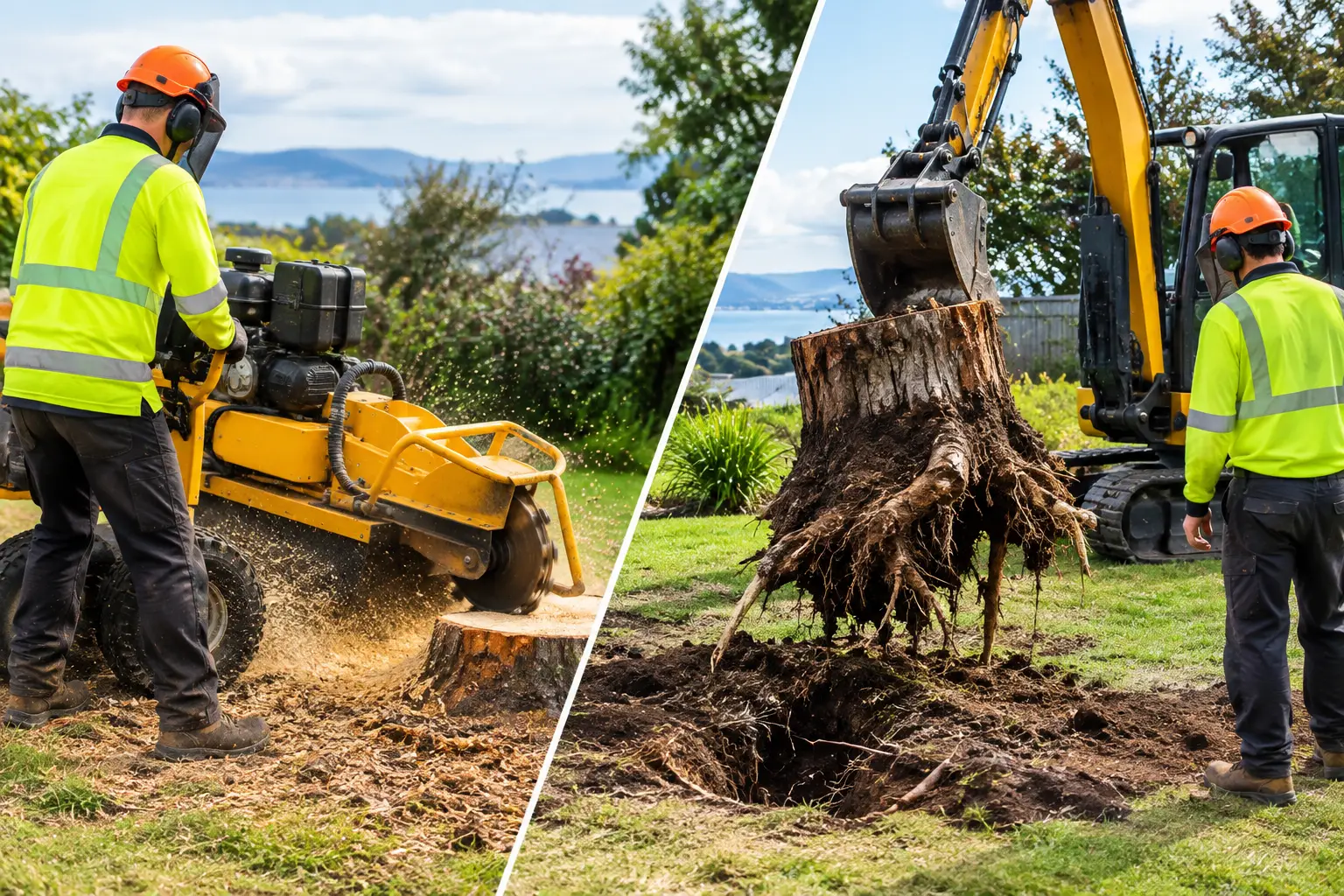
Stump grinding uses a purpose-built machine with a rotating cutting wheel to break the visible stump into woodchip. The stump is generally ground below soil level, allowing the area to be backfilled, levelled and prepared for grass, mulch or garden planting.
This method does not normally remove every large root from the ground. Instead, the underground root system is left to decay naturally over time. That is usually not a concern where the objective is to remove a trip hazard, improve the appearance of a lawn, or make room for a garden bed.
Grinding is often a good fit for residential properties because the machinery can be selected to suit the access available. A compact grinder may be used through narrower side access, while larger equipment can handle substantial stumps efficiently in open sections or development sites. The exact depth and extent of grinding should suit the intended use of the area.
The remaining woodchip is a key consideration. It can be removed from site, spread as mulch where appropriate, or incorporated into the backfill depending on the job and your plans for the space. Fresh grindings should not simply be mixed into a planting hole for a new tree, as decomposing wood can temporarily affect soil conditions.
When grinding is the practical choice
Stump grinding is usually the preferred option when the ground will remain as lawn, garden or a lightly landscaped area. It removes the visible obstruction without the major excavation needed to extract the root ball. That means less disturbance to surrounding turf, garden edges, paths and nearby trees.
It can also reduce risk around high-use areas. A low or hidden stump is easy to catch with a mower, trip over in poor light, or damage with garden equipment. Grinding removes that hazard and gives you a more usable surface.
For commercial grounds and rental properties, grinding can make routine maintenance simpler. Grounds crews are not left manoeuvring around an old stump, and the site presents better after tree removal work is complete. It is also a sensible option after storm damage, where restoring safe access and a clean site is the immediate priority.
There are limits. Some tree species are persistent re-sprouters and may send up new shoots from roots or around the ground stump. Grinding greatly reduces this issue, but it does not always prevent it entirely. If regrowth is a concern, the tree species and site conditions should be considered before work begins.
Stump grinding versus removal: the key difference
Full stump removal involves excavating the stump and its main root system from the soil. Depending on the size and species of the tree, this may require an excavator or other heavy equipment. The result is a clear area, but it also creates a larger hole and more disruption to the surrounding ground.
This approach is often necessary where you need a genuinely clear building platform. For example, a stump and structural roots may need to be removed before installing a driveway, constructing an extension, laying services, excavating for drainage, or preparing ground for a new structure. Leaving decaying wood beneath a hard surface can contribute to future settlement, so grinding alone may not be enough in these situations.
Removal may also be suitable when you want to replant in exactly the same location with a sizeable new tree. Old roots and compacted soil can make planting difficult, and clearing the root mass gives the replacement tree a better start. However, complete removal is not automatically required for every replanting project. Moving the new tree a short distance from the old stump can often protect soil quality and avoid unnecessary excavation.
The trade-off is site impact. Extracting roots can disturb lawn and garden areas, affect nearby fencing or paving, and require room for machinery and spoil handling. On tight urban sites, access can be the deciding factor. An experienced arborist will look beyond the stump itself and consider underground utilities, retaining structures, established planting and the safest route for equipment.
Consider what is beneath and around the stump
Before choosing either method, consider the stump’s position. A stump beside a house, fence, footpath, garden wall, pool area or underground service needs careful planning. Roots do not normally break sound pipes by themselves, but they can exploit existing cracks or joints. Excavation near services carries its own risks, which is why a site-specific approach matters.
Large old stumps can also be close to protected trees or valuable garden plants. Heavy machinery and excavation may compact soil or damage feeder roots in the surrounding area. In those cases, targeted grinding is often the lower-impact solution.
For land clearing and development projects, the decision is broader than one stump. The required finished ground level, future drainage, engineering requirements and access for construction equipment all affect the scope of root removal. Early coordination between the arboricultural team, earthworks contractor and project manager prevents costly rework later on.
How to choose the right option
Start with the outcome you need rather than the method. If you want a smooth lawn, a garden bed, safer access or a neat finish after tree removal, grinding will usually do the job well. If the site is being built on, excavated, paved or replanted in the same spot, full removal may be worth the additional disturbance.
It is also worth thinking about timing. Grinding can often be completed efficiently as part of a tree removal job, with the crew already on site and the work area established. Full removal may need a different machinery plan, additional reinstatement and coordination with other trades.
A clear quote should explain what is included: the intended grinding depth or removal extent, treatment of woodchip and spoil, site tidy-up, access requirements and whether reinstatement is part of the work. For managed properties and commercial sites, documented safety procedures and reliable scheduling are equally important. Health and Safety is in our DNA, particularly where machinery is operating near buildings, public areas or active work sites.
A clean finish starts with the right plan
There is no one-size-fits-all answer to stump grinding versus removal. Grinding gives most property owners a fast, tidy and practical result with minimal disruption. Removal delivers a more complete clear-out when future construction or ground works demand it.
The best decision comes from looking at the whole site: the tree species, stump size, access, nearby assets and what you need the area to become next. A capable arboricultural team can assess those details, use maintained professional equipment and leave the site clean, safe and ready for its next purpose.
For practical advice on the right approach for your property, visit www.treetechnician.co.nz