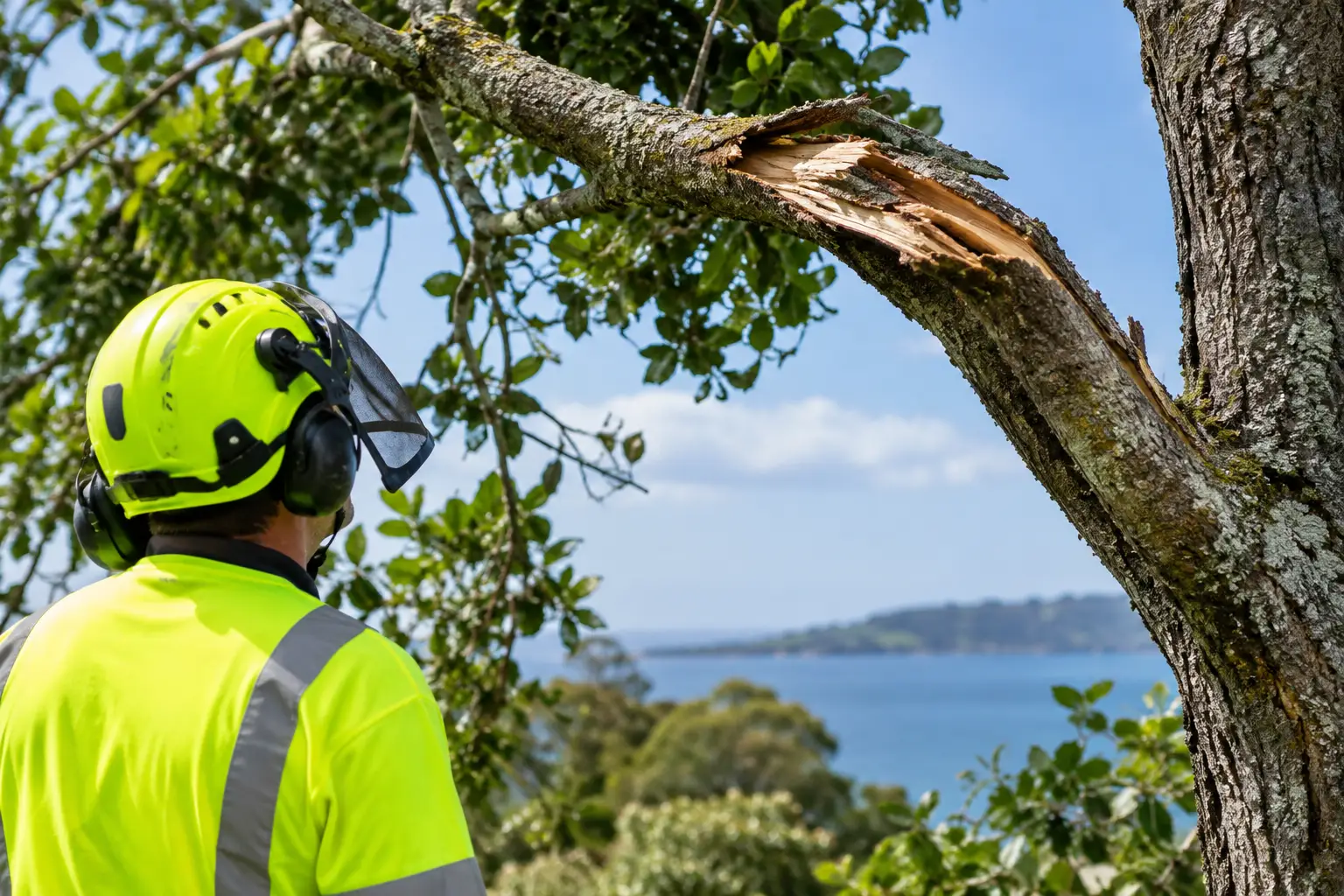
A branch can look perfectly sound from the ground, then come down without much warning during a strong nor’wester. Understanding why branches fail helps property owners make better calls before a tree damages a roof, blocks access, injures someone or creates an urgent clean-up job.
Branch failure is not always a sign that a tree has been neglected. Trees are living structures responding to wind, weather, growth, pests, soil conditions and past pruning. Some failures are unavoidable. Many, however, show signs that a qualified arborist can identify before the branch becomes a hazard.
Why Branches Fail: The Main Causes
Most branch failures come down to a combination of structural weakness and a triggering event. Wind may be the final push, but the underlying problem often started years earlier.
Weak branch attachments
Where a branch joins the trunk matters. A strong attachment usually has a clear branch collar and overlapping wood that helps support the limb. A weak attachment may have bark trapped between the branch and trunk, known as included bark. Instead of forming a strong union, the two stems press together as they grow.
This is especially common where a tree has two or more upright leaders competing for space. The union can appear solid, but it may split under the weight of foliage, rain, snow or wind. Co-dominant stems are worth inspecting early, particularly when they overhang buildings, driveways, footpaths or busy outdoor areas.
Decay inside the branch or trunk
Decay is one of the most significant reasons branches fail. Fungi can enter through old pruning wounds, storm damage, broken limbs or injuries to the trunk. The tree may continue to produce healthy-looking leaves while the wood inside is becoming less able to carry weight.
Look for fungal fruiting bodies, cavities, loose bark, deadwood, cracks or unusual swelling around old wounds. These do not automatically mean a branch will fail, but they are good reasons to arrange a professional assessment. The location and extent of decay matters more than any one visible symptom.
Excessive weight and overextended growth
Long, heavy limbs place considerable leverage on their attachment point. This often develops when a tree has grown freely for years, particularly on the outer canopy where branches stretch towards sunlight.
Dense foliage adds sail area in high winds. Rain can add weight, while a wet snow event can put sudden pressure on branches that are already carrying too much. Reduction pruning can sometimes reduce this loading, but it must be planned carefully. Cutting back too hard can stimulate weak regrowth, leave large wounds and create a different set of problems.
Storms and changing weather patterns
Canterbury conditions can test any tree. Strong winds, dry periods, sudden heavy rain and late snow can each expose a weakness that was not obvious beforehand. Wind does not affect every tree equally. A sheltered tree that has grown in a protected position may be more vulnerable after neighbouring trees are removed or a new development opens up the site.
A branch that survives one storm may still have been damaged. Check trees after severe weather for fresh cracks, hanging branches, split unions, lifted roots and limbs resting on power lines or structures. Keep well clear of damaged trees and do not attempt to pull down hung-up branches yourself.
Root stress and poor soil conditions
Healthy roots are the foundation of a stable canopy. Construction activity, trenching, soil compaction, changes to drainage, repeated vehicle traffic and damage around the root zone can all reduce a tree’s ability to take up water and support healthy growth.
Root problems do not always cause a branch to snap directly. More often, they lead to decline, dieback and reduced wood strength over time. A tree may respond by shedding limbs, or dead branches may remain in the canopy until wind brings them down. This is why tree management should be considered before building work begins, not only once damage appears.
Poor pruning and previous damage
Topping, flush cuts and indiscriminate lopping can leave a tree with large wounds and weakly attached regrowth. When a major branch is cut back severely, the tree may produce fast-growing shoots near the cut. These shoots can become sizeable limbs, but their attachment is often weaker than a naturally formed branch union.
Correct pruning is not simply about making a tree smaller. It is about selecting suitable branches, retaining the tree’s natural form where possible and managing weight without causing unnecessary stress. The right approach depends on the species, age, condition, location and the client’s goals for the site.
Warning Signs That Need Attention
No one can guarantee that a branch will never fail, but visible changes should not be ignored. A sudden lean, a new crack at a branch union or a limb that has dropped noticeably from its normal position deserves prompt attention.
Other signs include dead branches in the upper canopy, peeling bark, cavities, mushrooms at the base or on a limb, sawdust-like material from borer activity, and repeated loss of smaller branches. Also take note when a tree starts losing leaves early, develops sparse growth on one side or has branches rubbing together.
The risk is higher when a compromised branch sits above a house, shed, carpark, play area, entranceway or public space. In these situations, it is sensible to act before the next storm rather than wait for certainty. An arborist can assess the tree from the ground and, where needed, inspect the canopy more closely to determine whether pruning, bracing, monitoring or removal is the most appropriate option.
When Pruning Can Help – and When It Cannot
Targeted pruning can remove deadwood, reduce end weight, improve clearance and address selected structural issues. It is often a practical way to retain a valued tree while reducing risk. Young trees, in particular, benefit from formative pruning that encourages a stronger framework before defects become entrenched.
However, pruning cannot repair significant internal decay or turn a severely weak union into sound wood. In some cases, cabling and bracing may provide additional support for a structurally important tree. In others, the risk, cost of ongoing management and potential consequences of failure mean removal is the responsible option.
This is where an assessment matters. A decision should account for the tree’s condition, its targets beneath the canopy, the likelihood of failure and the work needed to manage it over time. A large tree in an open paddock presents a different level of risk from the same tree above a family home or commercial entrance.
What to Do After a Branch Fails
Treat fallen or partially failed branches as a safety issue first. Keep people, pets and vehicles away from the area, particularly if the branch is suspended, lodged in another tree or close to power lines. Do not climb the tree, use a ladder beside it or cut timber that is under tension. Branches can shift suddenly as weight is released.
If access is blocked or the tree has damaged a building, fence or vehicle, take clear photos from a safe distance for records and contact your insurer where appropriate. Emergency tree work may be needed to make the site safe, followed by a fuller assessment of the remaining tree. The branch that fell may not be the only concern.
A Practical Approach to Safer Trees
The most useful time to assess a tree is before it becomes an emergency. Regular checks are particularly worthwhile for mature trees, trees near buildings and trees affected by construction, drought, storm damage or previous poor pruning. An experienced arborist can identify defects, explain the level of risk in plain language and recommend work that suits the tree and the site.
At Tree Technician, health and safety is in our DNA. Our team provides practical tree assessments, careful pruning, hazard management and emergency response for property owners across Canterbury. The aim is straightforward: keep the trees worth retaining in good condition, and deal with unacceptable risks safely and professionally.
If a branch looks different, heavier, cracked or stressed after bad weather, trust that observation. Early advice can often turn a worrying tree problem into planned, manageable work.
www.treetechnician.co.nz