
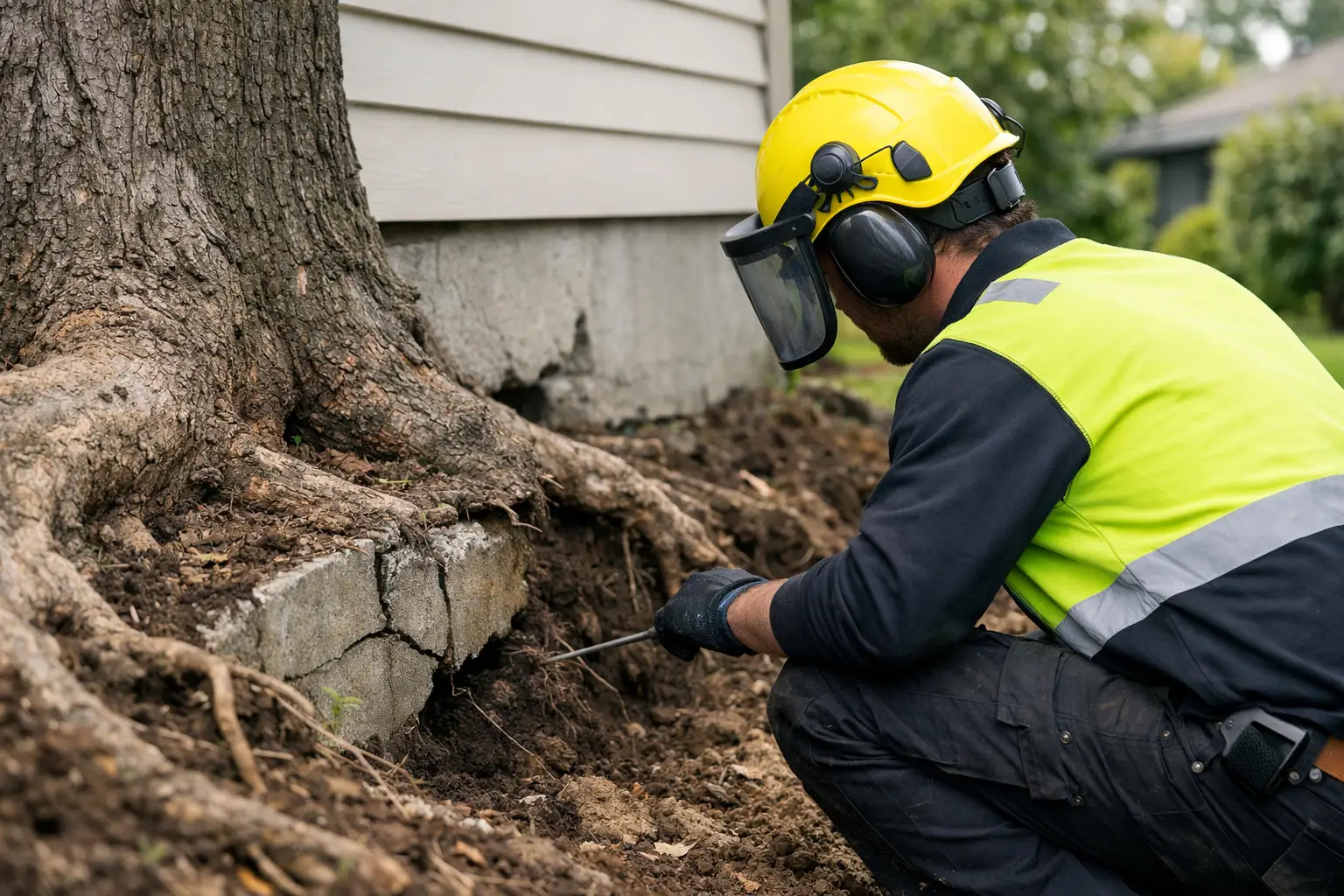
A mature tree can add significant value to a property, providing shade, privacy and character. But when cracking appears in a brick wall or a door starts sticking, drive or path starts lifting, it is natural to ask: can trees damage foundations? The answer is yes, in some situations, but roots are not always the cause and removing a tree without proper advice can sometimes make ground movement worse.
The first step starts with an proper assessment of the tree, the soil, drainage and the building itself. That gives you a clear picture of the actual risk before any pruning, removal or construction work begins.
Can trees damage foundations?
Trees rarely force their way through sound concrete foundations. Most tree roots grow through soil, following moisture, oxygen and existing gaps. Where foundations, drains or paving already have cracks or weak points, roots may enter and enlarge them over time. This can make existing damage more visible, but it is often not the original cause.
The more common issue is soil movement. Trees draw water from the ground through their roots. In reactive clay soils, that loss of moisture can cause the soil to shrink during dry periods. If the soil beneath part of a house moves more than the soil beneath another area, the building can settle unevenly. This may lead to cracking in walls, uneven floors, jammed windows or gaps around doors.
The risk depends on several factors working together. A large, thirsty tree close to a shallow footing in highly reactive clay is more likely to contribute to movement than a small ornamental tree in stable, well-drained soil. Poor drainage, leaking pipes, building age and previous ground disturbance can all be part of the picture too.
Why soil type matters as much as the tree
Not every property reacts to trees in the same way. Sandy and free-draining soils are generally less prone to shrink-swell movement than clay-rich ground. Clay can expand when wet and contract as it dries, which puts changing pressure on footings, paths and retaining walls.
A tree’s water demand also changes through the year. During a hot, dry spell, an established tree may draw substantial moisture from the surrounding soil. That does not mean the tree is automatically unsafe or unsuitable, but it does mean its position should be considered when there is movement in a nearby structure.
Conversely, excess water can be just as damaging. A blocked drain, broken stormwater pipe or poor surface drainage can saturate soil near a foundation. Roots are often blamed because they are visible when excavation begins, yet a drainage defect may be the underlying issue. Identifying both the tree and water-management factors prevents an expensive fix that does not solve the problem.
Roots and drains are a separate concern
Roots are more likely to affect older or damaged drains than modern, well-installed pipework. If a pipe joint has failed or a crack is already present, fine roots can enter in search of moisture. Once inside, they can form a dense mass that restricts flow and causes repeated blockages.
A drain camera inspection is the sensible first step where sewage or stormwater problems are suspected. It confirms the condition and location of the pipe before roots are cut or a tree is removed. Treating the roots alone may provide short-term relief, but a damaged pipe still needs repair.
Signs worth checking early
One hairline crack does not prove a tree-related foundation problem. Buildings naturally settle, materials expand and contract, and minor surface cracking is common. The concern increases when changes are new, widening or recurring in the same area.
Keep an eye out for several signs occurring together:
- stepped cracks through brickwork or masonry, particularly near windows and doors;
- doors or windows that suddenly bind, stick or no longer latch properly;
- gaps opening between internal walls, skirting boards, ceilings or cornices;
- sloping floors, cracked paving or movement around a verandah, driveway or retaining wall; and
- repeated drainage blockages close to a large tree.
Take dated photographs and note whether cracks change after prolonged rain or dry weather. This record can be useful for a building professional, engineer or arborist assessing the cause. Avoid filling and repainting over active cracks before their pattern has been reviewed, as that can hide useful evidence.
Distance is a guide, not a guarantee
There is no single safe distance that applies to every tree and every home. Root systems extend well beyond the canopy, although the majority of fine feeding roots are usually found in the upper layers of soil where oxygen and moisture are available. A tree’s eventual height, crown spread, species, soil conditions and the type of footing all matter.
As a practical starting point, the larger the mature tree and the more reactive the soil, the more carefully its location should be considered. Fast-growing species with high water demand can require greater separation from buildings than smaller, slower-growing trees. Existing trees should be assessed on their actual size and condition, not simply the species name on a planting label.
For new planting, plan for the tree at maturity. Consider buildings, underground services, drainage lines, driveways, retaining walls and neighbouring properties. Choosing the right species for the available space is usually far more effective than repeated hard pruning later.
Do not rush into tree removal
When a foundation concern is raised, it can feel logical to remove the nearest tree immediately. However, removing a mature tree can change soil moisture again. In reactive ground, the soil may rehydrate and expand after removal, creating a different form of movement known as heave.
That does not mean a problematic tree should always stay. It means removal needs to be planned with the whole site in mind. A qualified arborist can assess the tree’s health, species, root zone, size, structural condition and likely contribution to the issue. Where building movement is significant, a structural engineer or suitably qualified building professional should assess the foundation and cracking.
The best outcome may be monitoring, drainage repairs, selective canopy reduction, root management in appropriate circumstances, or carefully staged removal. Each option has trade-offs. Heavy pruning can reduce a tree’s water use temporarily, but excessive pruning may weaken the tree or trigger regrowth. Root cutting near a mature tree can affect stability and health, particularly if major roots are severed on one side.
A practical approach for property owners
Start by checking the basics. Make sure downpipes discharge correctly, surface water falls away from the building, and obvious leaks are repaired promptly. Keep paving and garden beds from directing water against the house. These measures support foundation performance regardless of whether a tree is involved.
Next, arrange appropriate inspections rather than relying on guesswork. An arboricultural assessment can identify tree-related risks, including poor structure, root-zone constraints, decay or unsuitable proximity to buildings. A drainage specialist can inspect suspect pipes, while an engineer can determine whether cracking indicates structural movement and what remediation is needed.
For commercial sites, body corporates, schools and land managers, documented assessments are particularly useful. They help prioritise work, support maintenance planning and provide a clear record of why action was taken. This is valuable where large trees sit near occupied buildings, car parks, accessways or public areas.
Protect trees during building work
Foundation repairs, extensions and new services can damage trees as readily as trees can affect structures. Excavation through the root zone may destabilise a tree or lead to decline months later. Before machinery enters a site, identify significant trees and set practical protection zones around them.
An arborist can advise on root-sensitive excavation methods, site supervision and pruning that meets the needs of both the project and the tree. This is especially worthwhile for established trees that contribute to shade, amenity or compliance requirements.
A tree near a house is not automatically a problem, and a crack in a wall is not automatically caused by roots. The most sensible next step is to investigate early, use the right specialists and make decisions based on the conditions on your property. That protects your foundation while giving any valuable tree a fair and informed assessment.