A weed spray that clears a fence line in a week can damage a mature tree for years. If you have searched for “broadleaf chemicals and trees: do’s and don’ts”, you are likely looking for advice on broadleaf herbicides and how to use them without putting established trees, shelterbelts, hedges or newly planted specimens at risk.
The short version is simple: broadleaf weed control and healthy trees can coexist, but only when the product, application method, weather and site conditions are properly considered. A lawn, paddock edge or development site is rarely just weeds. Tree roots often extend well beyond the canopy, and chemical drift does not always stay where it was intended.
Broadleaf chemicals and trees: the key risk
Broadleaf herbicides are designed to control broadleaf plants rather than grasses. Some are selective and commonly used in turf or pasture. Others are non-selective, residual, or capable of moving through a treated plant’s system. Their suitability near trees depends on the active ingredient, formulation and label directions, not simply the word “broadleaf” on the product description.
Trees can be affected in several ways. Spray drift may settle on foliage, especially during windy conditions. Fine droplets can travel further than expected, while vapour from certain products may move after spraying in warm weather. Chemicals can also enter through exposed roots, freshly cut stumps, wounds, compacted soil or water moving across the site.
Damage is not always immediate. Leaves may cup, curl, yellow or develop uneven growth several weeks after application. New shoots can be distorted, branches may die back, and stressed trees can become more vulnerable to drought, pests, disease and storm damage. By the time symptoms are obvious, the application has long since finished.
Do identify the weed before choosing a chemical
The right treatment starts with the weed, not the spray bottle. Clover in a lawn, gorse on a rural boundary, thistles in pasture and woody regrowth around a building site need different approaches. Applying a broadleaf product without identifying the target can lead to poor results and unnecessary repeat spraying.
Consider whether chemical control is needed at all. Small infestations can often be hand-removed, mulched over, cut repeatedly or managed through improved groundcover. Around valuable trees, these lower-risk options are often worthwhile. A layer of suitable mulch, kept clear of the trunk, can suppress weeds while helping soil retain moisture.
For larger areas, select a product approved for the intended setting and target species. Read the current label every time, even if you have used a similar product before. Labels set out application rates, weather limits, buffer requirements, protective equipment and restrictions around waterways, gardens and desirable plants.
Do protect the tree’s root zone
A tree’s roots are not contained by the edge of its canopy. Fine feeder roots commonly extend well beyond the dripline, particularly in open ground. That means spraying bare soil beneath or beside a tree can be more risky than it looks.
Avoid applying residual herbicides within the root zone of desirable trees unless the product label specifically allows it and the use is appropriate for the site. Residual products can remain active in soil and may be taken up by roots after rainfall or irrigation. This is a particular concern for young trees, drought-stressed trees and trees growing in shallow, sandy or compacted soil.
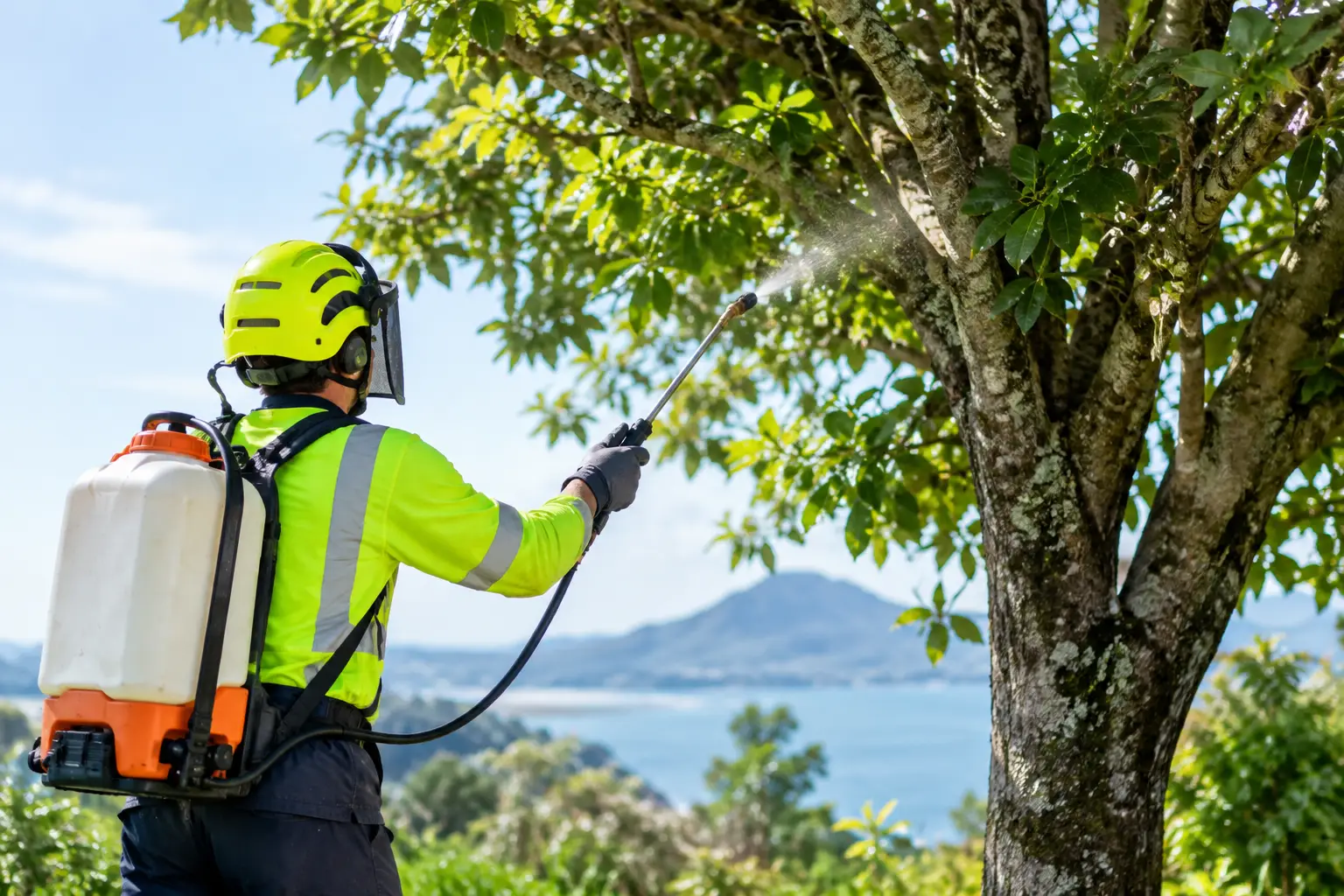
If weeds need treating close to trunks or surface roots, spot treatment is generally safer than broad spraying. Use a shielded nozzle, coarse droplets and the lowest effective application rate permitted by the label. Keep the spray directed at the weed foliage, not the soil, bark, suckers or low branches.
Do choose the right conditions
Weather makes a real difference. Do not spray when wind could carry droplets into a tree canopy, neighbouring garden, waterway or public area. Still conditions are not automatically safe either, as temperature inversions can keep fine droplets suspended close to the ground and move them later.
Avoid spraying stressed vegetation in very hot, dry conditions unless product directions say otherwise. Trees already coping with heat, low soil moisture, root disturbance or recent pruning have less capacity to tolerate additional stress. Rain can also wash product off foliage before it works or move chemicals through the soil profile.
Plan the job for a calm, mild day within the product’s stated weather range. Check the forecast, use suitable equipment and stop if conditions change. On commercial sites and larger properties, record the product, rate, weather, operator and treatment area. Good records support safe maintenance and make it easier to investigate any later plant symptoms.
Don’t assume a lawn-safe product is tree-safe
A selective broadleaf herbicide may be suitable for controlling weeds in turf, but that does not mean it is harmless to every tree, shrub or hedge nearby. Some ornamental and native species are highly sensitive to even small amounts of drift. New leaves and soft spring growth are often most vulnerable.
Take extra care around fruit trees, vegetable gardens, flowering ornamentals, native plantings and shelterbelts. Do not spray beneath overhanging branches just because the product is safe for grass. Check the product label for sensitive species, replanting intervals and any warnings about use near roots.
Also avoid using more product than directed. Higher rates do not necessarily improve weed control, but they do increase the chance of off-target damage. Accurate mixing, calibrated equipment and a measured application are part of professional, responsible site care.
Don’t spray damaged, cut or freshly disturbed trees
Tree work and weed control need to be coordinated. Fresh pruning cuts, bark damage, exposed roots and disturbed soil all create conditions where a tree may be more susceptible to stress. After tree removal, chemical stump treatment may be appropriate for preventing regrowth, but it must be targeted to the correct species and kept away from retained trees.
Never use a general herbicide treatment as a shortcut around a tree you want removed. Uncontrolled decline can create a hazard tree, make removal more complex and affect nearby vegetation through shared or overlapping root zones. If a tree is unwanted, diseased or structurally unsafe, obtain arboricultural advice and arrange the right removal process.
On development sites, protect retained trees before machinery, excavation, spraying or stockpiling begins. Soil compaction and root damage are already major threats. Adding unsuitable chemical use can turn a manageable impact into long-term decline.
Don’t ignore early signs of herbicide injury
Leaf distortion, scorched edges, unusual yellowing and stunted new growth can have several causes, including drought, nutrient issues, insect activity and disease. However, if symptoms appear soon after nearby spraying, herbicide exposure should be considered.
Stop further applications in the area and document what has happened. Take clear photographs, note the dates symptoms appeared, retain product details and identify where spraying occurred. Watering may help a drought-stressed tree, but there is no universal remedy that reverses herbicide uptake. Avoid fertilising or heavily pruning a stressed tree without advice, as this can add further pressure.
A qualified arborist can assess the tree’s condition, likely contributing factors and immediate risk. For high-value, protected or public-facing trees, early assessment is particularly sensible. It helps you make decisions based on the tree’s actual condition rather than guessing from a single symptom.
When professional help is the safer option
Chemical weed control is often useful, especially across large grounds, rural boundaries and hard-to-manage sites. The risk rises when weeds sit near mature trees, waterways, neighbouring properties, public spaces or protected vegetation. That is where a planned approach is worth it.
For Canterbury property owners, managers and developers, Tree Technician can help assess trees before work begins, identify protection zones and coordinate practical tree management around clearing, maintenance and site works. Health and safety is in our DNA, and protecting the trees worth keeping is part of doing the job properly.
The best result is not simply a weed-free site. It is a clean, manageable property where the trees you value remain healthy, stable and well positioned for the years ahead.
www.treetechnician.co.nz
Get a free quote
Contact Tree Technician for a free, no-obligation quote.
Explore Tree Trimming & Pruning