A tree can look perfectly healthy from the kitchen window and still have a serious structural problem higher up or below ground. A heavy limb over a driveway, a leaning tree beside a home, or storm-damaged branches above a footpath can quickly become a safety issue. Knowing how to assess tree hazards helps property owners act early, protect people and property, and retain healthy trees where possible.
A sensible assessment is not about assuming every large or old tree needs to come down. Mature trees provide shelter, character and environmental value. The job is to identify whether there is a credible chance of failure, what the likely target is, and whether pruning, support work, monitoring or removal is the most appropriate response.
Start with the target, not just the tree
A tree defect only becomes a significant hazard when there is something that could be hit if it fails. Arborists call this a target. It may be a house, shed, fence, vehicle, play area, accessway, power line, public footpath or a place where people regularly gather.
Start by looking at how the area is used. A dead branch above an unused corner of a large rural block needs a different response from the same branch above a school gate or commercial car park. Frequency matters too. A driveway used twice a day carries less exposure than a busy entrance used by staff, visitors and delivery vehicles throughout the day.
This does not mean a low-use area can be ignored. It means the level and urgency of management should fit the actual risk. Restricting access may be an immediate control while a qualified arborist plans the right work.
How to assess tree hazards from ground level
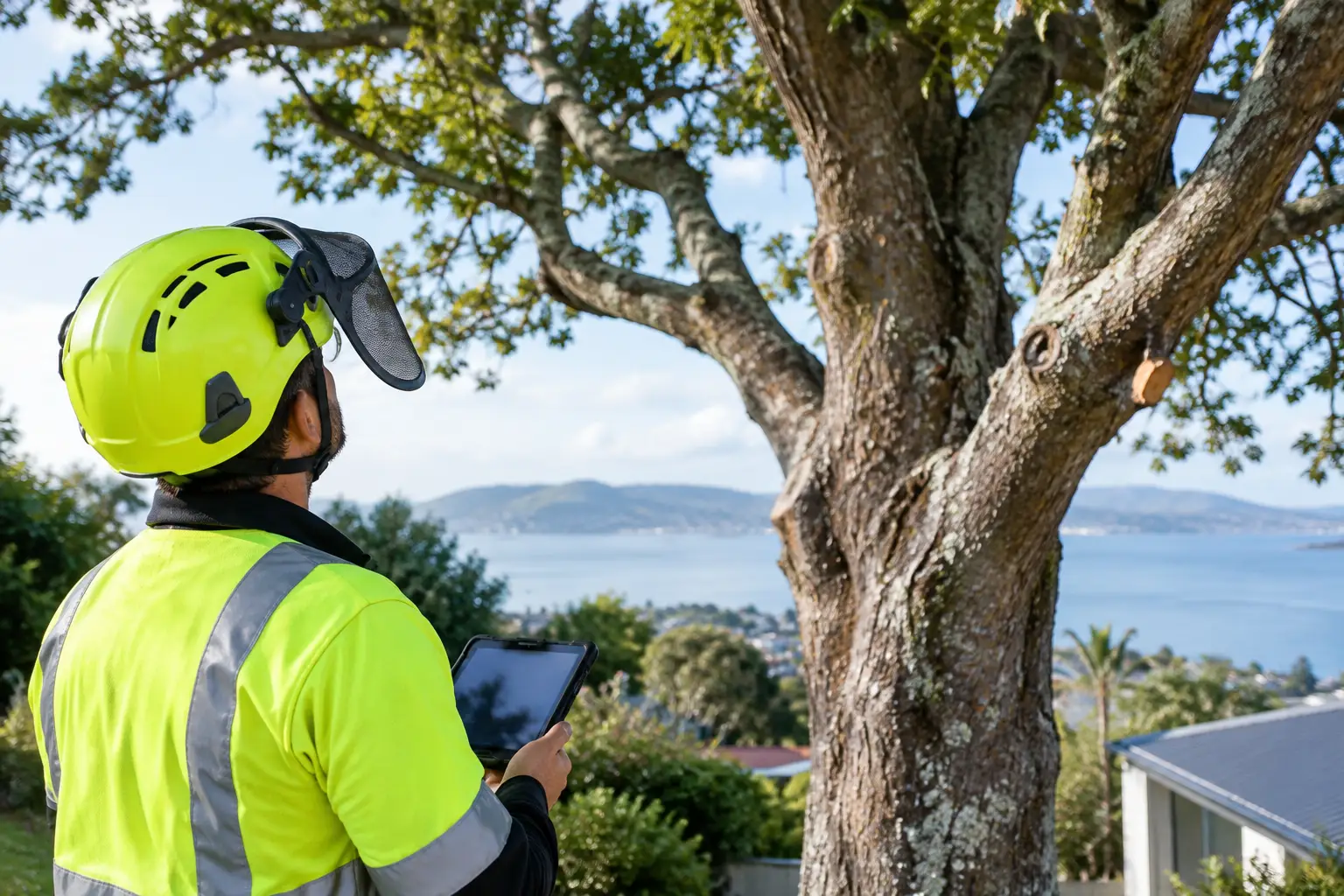
A ground-level check is a useful first step, provided you stay out of the drop zone and do not try to climb, cut or pull on suspect branches. Walk around the tree slowly, viewing it from several angles. Take clear photos from a safe distance if you need advice from an arborist or property manager.
Check the crown for dead, broken or poorly attached branches
Look into the canopy for branches with no leaves when surrounding growth is in leaf, peeling bark, bare twigs, cracks, hanging limbs or branches caught up in the crown. Deadwood is common in older trees and does not automatically mean the whole tree is unsafe, but its position and size matter greatly.
Pay particular attention to large lateral limbs extending over buildings, outdoor living areas, roads and parking spaces. Also look for branches with tight, V-shaped joins, especially where two similarly sized stems grow from the same point. These unions can contain included bark, where bark is trapped between stems rather than forming a strong wood connection. Under wind or weight, that junction can split.
Look for changes in lean or movement
A tree that has always grown on a slight angle is not necessarily unstable. The concern is a recent or increasing lean, particularly after strong wind, saturated ground, excavation or root disturbance. Freshly exposed soil on one side of the root plate, lifted turf, new cracks in the ground, or roots beginning to heave are warning signs that the tree may be moving.
Do not stand beneath or directly downhill from a leaning tree to investigate it. Keep people, vehicles and pets clear, particularly during wet or windy conditions, and arrange an urgent professional assessment.
Inspect the trunk for defects
From the ground, look for long vertical cracks, open seams, cavities, fungal fruiting bodies, loose bark, swelling around old wounds, or sections of trunk that appear flattened or hollow. A cavity is not a verdict by itself. Trees can compartmentalise decay and continue to stand safely for many years. However, decay combined with a large canopy, a high-value target, a crack or root instability can materially increase the likelihood of failure.
Fungi at the base of a tree deserve attention because some species indicate root or butt decay. Photograph the fungus rather than removing it, as identification can help inform an assessment. The absence of visible fungi is not proof that roots are sound, but their presence can be a valuable clue.
Examine the root zone and recent site activity
Many tree failures begin below ground. Roots may be affected by trenching, driveway construction, retaining work, soil compaction, changes to drainage, stock damage or repeated vehicle traffic. Development work close to a tree can remove anchoring roots without obvious symptoms appearing straight away.
Check for cut roots, compacted soil, pooling water, newly altered levels around the trunk or machinery damage. Avoid piling soil, mulch or building materials against the base of the tree. Root health depends on oxygen as well as moisture, and changing ground levels can create avoidable stress.
Warning signs after storms and dry periods
Canterbury weather can put trees under pressure in different ways. Strong winds may expose weak unions and deadwood, while extended dry periods can reduce vigour and make some trees more vulnerable to pests, disease and branch drop. Heavy rain can saturate soil and reduce root anchorage, especially where drainage is poor.
After a significant weather event, inspect trees from a safe distance before allowing normal access beneath them. Look for new hangers, split limbs, fresh cracks, fallen twigs or branches, and movement around the base. If a branch is tangled in the canopy, leave it alone. Cutting from the ground can cause unpredictable movement, and attempting to dislodge it can put people directly in harm’s way.
For an immediate threat to people, buildings or access, isolate the area and contact a professional emergency tree service. Never approach branches that are touching or close to power lines. Treat the situation as live and contact the electricity network operator or emergency services where required.
Tree health and tree hazard are not the same thing
Poor health can contribute to risk, but a declining tree is not always dangerous and a leafy tree is not always structurally sound. A tree may have excellent foliage while carrying hidden decay, poor branch unions or compromised roots. Equally, a tree under temporary stress may look sparse yet remain structurally stable.
This is why visual checks should consider the whole tree: crown, trunk, root zone and target. Species, age, form, growing conditions, pruning history and exposure to wind all influence the final judgement. An isolated dead branch may only need careful pruning. A mature tree with basal decay beside a building may need a more detailed assessment, possibly with specialist investigation and a management plan.
Know when to call a qualified arborist
Call for professional advice when you see a large dead or hanging branch, a fresh crack or split, a new lean, root plate movement, decay near the base, or damage following a storm. The same applies where a tree is close to a home, neighbour’s property, road, public area or power infrastructure.
A qualified arborist can assess defects in context rather than relying on a single sign. They can recommend proportionate options such as deadwood removal, selective reduction pruning, cabling and bracing, monitoring, exclusion zones, or removal where there is no reasonable way to manage the risk. This approach often preserves a valuable tree while dealing with the part that creates the problem.
Formal written assessments are particularly useful for commercial sites, body corporates, schools, developments and landholders managing multiple trees. They create a clear record of observations, priorities and recommended maintenance, helping managers plan work and demonstrate a responsible approach to safety.
Avoid the quick fixes that create bigger problems
Topping a tree, cutting major limbs without a plan, or removing roots to make mowing easier can create new hazards. Severe pruning can trigger weak regrowth, expose the tree to decay and alter how it responds to wind. Likewise, hiring equipment without the training to use it around elevated branches is a common path to injury and property damage.
Good tree risk management is measured, not dramatic. The best outcome may be a small amount of targeted pruning, a cable installed by a specialist, a protected root zone during construction, or planned removal before a compromised tree fails. Health and Safety is in our DNA, and the right method protects the people on site as well as the tree’s future.
If you are unsure about a tree, trust the warning signs and keep clear rather than taking chances. A timely, professional assessment gives you a practical plan and the confidence to act before a manageable issue becomes an emergency.
www.treetechnician.co.nz