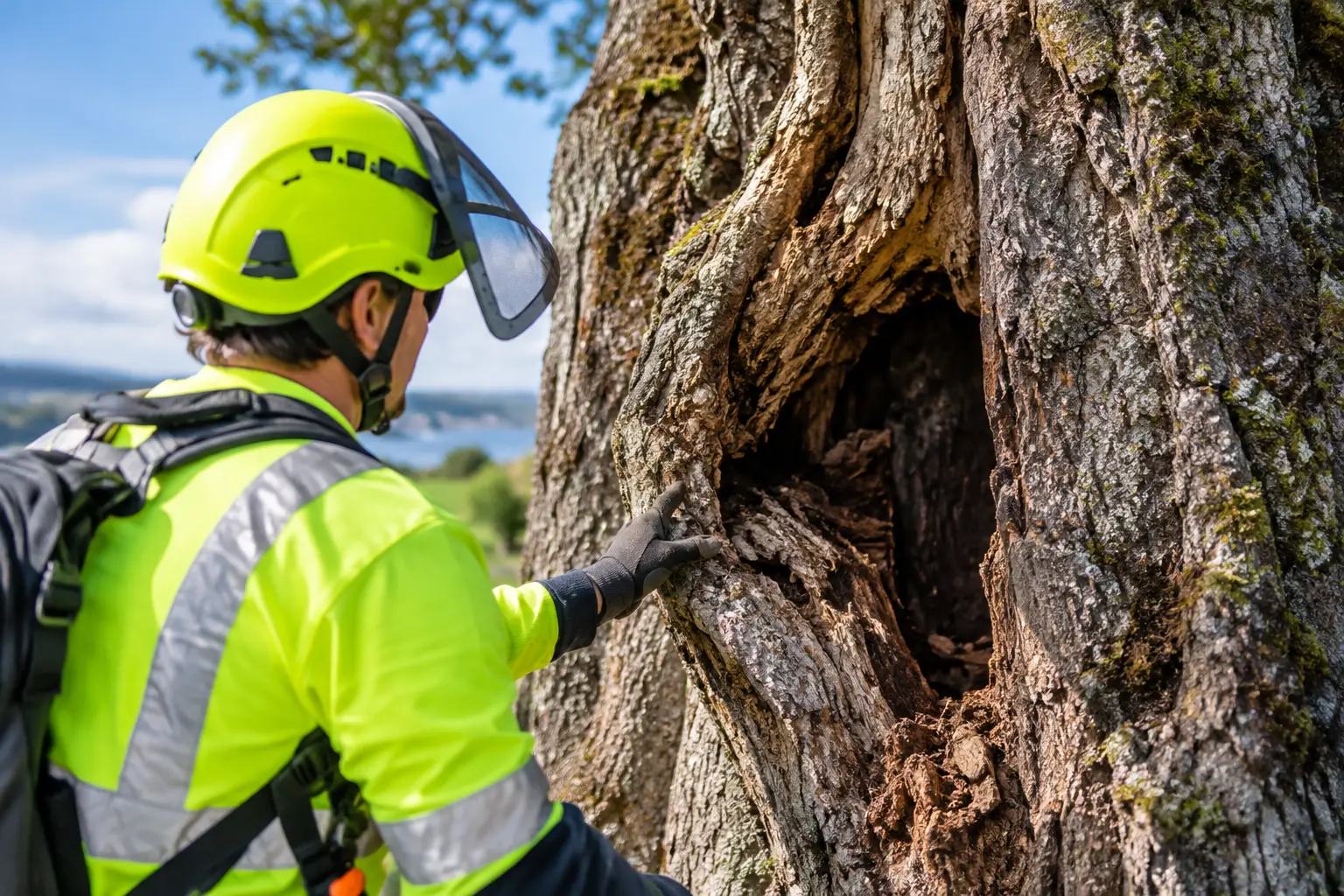
A hollow in a mature tree can look alarming, particularly when it sits above a driveway, outdoor area, roofline or public accessway. But a cavity does not automatically mean the tree is unsafe or needs removing. A professional tree cavity inspection looks beyond the opening to assess what is happening inside the stem, how much sound wood remains, and whether the tree can safely continue to stand.
For property owners, the aim is simple: make a clear, informed decision before decay, high winds or a heavy branch turn a manageable issue into an emergency.
What a tree cavity can tell you
Tree cavities develop when wood in the trunk or a major limb dies and breaks down. This may follow storm damage, a poorly made pruning cut, limb failure, fire damage, fungal decay, animal activity or a previous wound that has never properly compartmentalised. Trees do not heal in the same way people do. Instead, they create barriers around damaged tissue and grow new wood around it.
That process means a tree can sometimes remain structurally sound despite having a large visible hollow. In other cases, a small opening can lead into extensive internal decay. The size of the hole alone is not a reliable guide to risk.
A cavity needs to be considered alongside the tree’s species, age, form, overall condition, location and exposure. A hollow old tree in a paddock may be a valuable habitat feature with little practical risk. The same tree over a neighbour’s fence, car park or children’s play area requires a more cautious assessment.
What happens during a tree cavity inspection
A proper inspection begins from the ground. An arborist considers the whole tree rather than focusing only on the hollow. They look at the crown, trunk, root area, branch attachments and the surrounding site to identify signs of stress, movement or previous failure.
The cavity itself is assessed for its position, dimensions, edge condition and likely cause. Sounding the surrounding timber, using a mallet or specialist tools where appropriate, can help identify changes in wood density. Depending on access and the question that needs answering, the inspection may also involve climbing inspection techniques or further diagnostic testing.
The key question is not simply, “Is there decay?” Most older trees contain some deadwood or decay. The question is whether the remaining live and sound wood can withstand the loads placed on the tree, including wind, rain-soaked foliage and the weight of long limbs.
An assessment also considers targets. In arboriculture, a target is anything that could be affected if a tree or branch fails – people, buildings, vehicles, power infrastructure, fences, footpaths or neighbouring land. A cavity in a low-risk location may be monitored. A similar defect over a high-use area may need risk reduction work sooner.
Warning signs that call for prompt attention
Some cavities are stable for years, but changes around a hollow should not be ignored. Fresh cracking, peeling bark, soft or crumbly timber, visible fungal fruiting bodies, water pooling inside the cavity or sudden dieback in the canopy can indicate that decay is progressing.
Movement is another concern. If the trunk appears to flex unusually around the cavity, a major limb is dropping, or a crack opens after strong winds, keep people and vehicles away from the area. Do not climb the tree, probe deeply into the hollow, or cut branches off without proper equipment and a plan. Removing weight from the wrong part of a compromised tree can make failure more likely.
In Canterbury, dry conditions can place trees under stress, while strong winds can expose structural weaknesses that have gone unnoticed. After a storm, it is sensible to check established trees near homes, accessways and work areas, especially where there has been old damage or visible hollows.
A cavity is not always a reason to remove a tree
The best outcome is often to retain a worthwhile tree while reducing the risk around it. Selective pruning may shorten or lighten an overextended limb, remove deadwood and reduce sail area. In some situations, cabling or bracing can support a weak union or valuable limb, although these systems are not a cure for advanced decay and require ongoing inspection.
Moving a seating area, parking space or regular access route can also reduce exposure without changing the tree itself. This may suit a significant mature specimen, a protected tree or one that provides shade, screening and habitat value.
Removal becomes the sensible option when structural integrity is too compromised, targets cannot reasonably be managed, or the tree is declining beyond recovery. It can be disappointing to lose a mature tree, but planned removal is far safer and more controlled than waiting for a failure. Where removal is needed, a competent crew can dismantle the tree in sections, manage access and leave the site tidy.
The right recommendation depends on the evidence. A good arborist will explain the level of risk, the available options and the likely consequences of waiting, rather than treating every cavity as an automatic removal job.
Why filling cavities is usually the wrong approach
Older practices sometimes involved filling hollows with concrete, foam or other materials. This does not restore the tree’s strength. In fact, rigid material can create new stresses as the tree moves in wind, while filling can trap moisture or prevent future inspection of the cavity.
Cleaning out a hollow can also do more harm than good. Decayed material and wildlife habitat may be removed unnecessarily, and the remaining wood can be damaged. The useful approach is to assess the cavity, manage the load on the tree if required, and monitor any change over time.
There are exceptions where a site-specific treatment may be considered, but these should follow professional advice. Trees are living structures, not damaged fence posts, and each response needs to suit the species and situation.
When monitoring is the sensible option
Monitoring is appropriate only when the tree has an acceptable level of risk and there is a clear reason to retain it. This could include a stable cavity with adequate sound wood, low occupancy beneath the tree and no signs of rapid decline.
A monitoring plan should be practical. It may include photos from the same position, measurements of cracks or cavity openings, scheduled inspections and instructions to reassess after major storms. If the tree is near a building, school, commercial site or shared access area, written records can also support responsible property management.
Do not rely on a one-off inspection forever. Trees change with seasons, growth, drought, construction activity and weather events. A cavity that was manageable last year can become more significant after a limb breaks or the crown loses vigour.
Protecting trees during building and site work
Cavities can worsen when trees are stressed by nearby construction. Excavation, trenching, soil compaction, changes to drainage and vehicle movements over roots can reduce a tree’s ability to respond to existing decay. Damage may not appear immediately, which is why trees near proposed development benefit from early arboricultural input.
For developers and property managers, identifying cavity-bearing trees before works begin helps avoid costly changes later. An assessment can establish whether a tree can be retained, what protection measures are needed and whether consent or protected-tree requirements apply. It also gives contractors clear boundaries around root zones, access and pruning.
Choose an assessment that gives you clear answers
A tree cavity inspection should leave you knowing what the defect means for your property and what action, if any, is required. Ask for advice in plain language: whether the tree is suitable for retention, what work is recommended, how urgently it should occur and when it should be reviewed again.
Tree Technician brings practical field experience and formal arboricultural judgement to cavity assessments across Canterbury. Health and Safety is in our DNA, from the initial inspection through to pruning, bracing, removal or ongoing management.
If a hollow tree is making you uneasy, arranging an assessment before the next strong wind is a sensible first step. The right advice can protect people and property while giving a good tree every reasonable chance to remain part of the landscape.
www.treetechnician.co.nz