A leaning pine after a nor’wester, a gum dropping limbs over the driveway, or a hedge swallowing the front path can turn a simple property job into a safety issue quickly. When you search for tree services near me, the closest operator is not always the right one. The best result is a team that is qualified, can assess the risk, explain what is required clearly, protect people and property, and leave the site tidy when the job is done.
For Canterbury homeowners, property managers, rural landholders and developers, tree work is usually a bit more involved than just trimming branches. It can mean looking after a tree’s health, working safely around powerlines or buildings, meeting council requirements, or dealing with storm damage in a way that keeps people out of harm’s way. Having a qualified arborist look at things early helps you make the right call before a small issue turns into a costly one.
What to look for in tree services near me
A tree can look healthy from ground level while having decay, poor branch structure or root damage that changes the risk completely. Equally, a mature tree that appears overgrown may only need careful pruning rather than removal. This is why an on-site assessment matters.
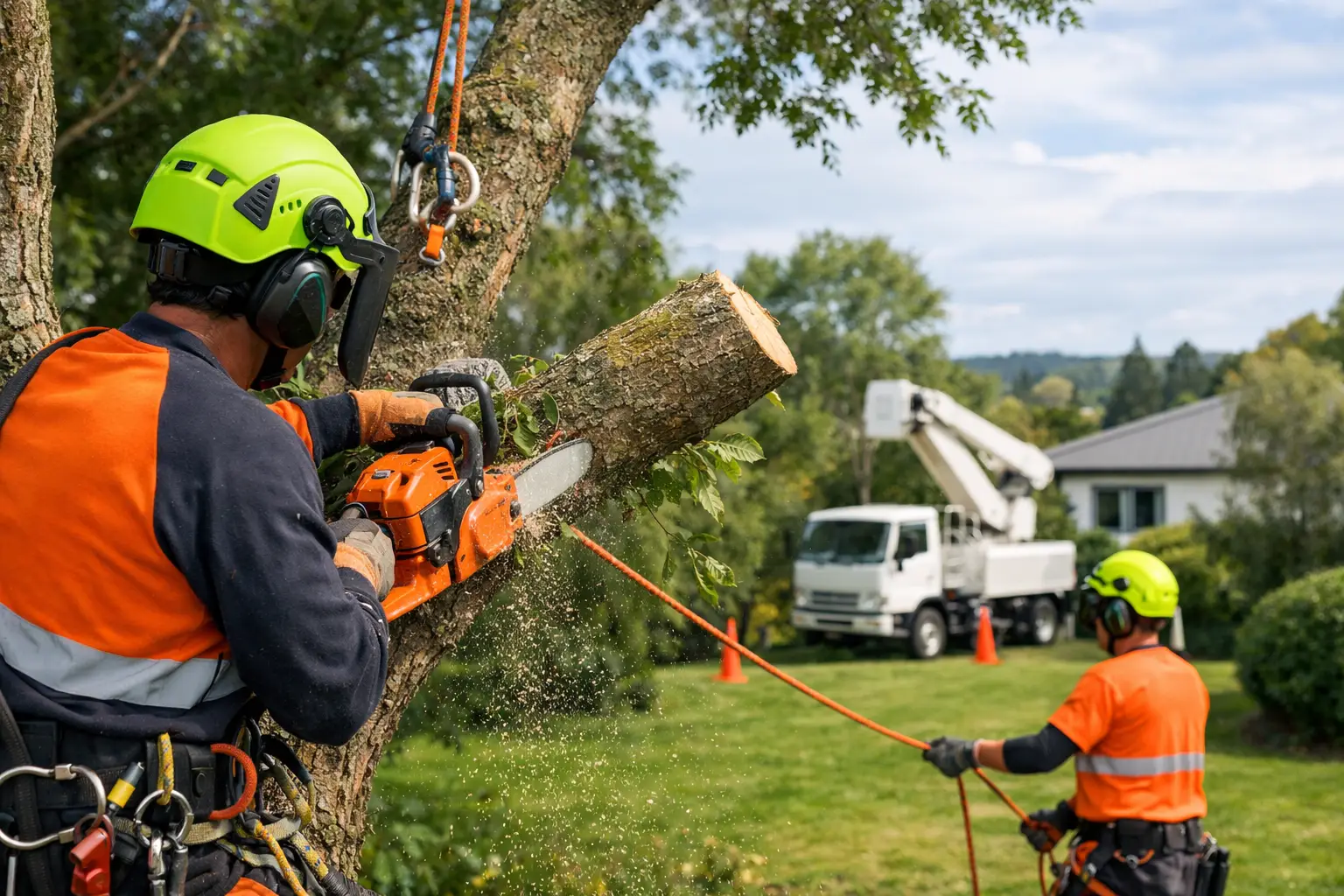
A professional tree crew should first look at the tree itself, its location and what sits within its fall zone. That includes homes, sheds, fences, driveways, neighbouring properties, footpaths, vehicles and overhead services. They should consider access for equipment, ground conditions, traffic or pedestrian management, and a safe way to lower or remove material.
Ask whether the company carries industry qualifications, appropriate insurance, uses maintained equipment and has documented health and safety systems. Tree work is specialised work at height, often involving chainsaws, rigging, elevated work platforms and heavy machinery. Choosing a team with proven safety practices is not paperwork for its own sake. It protects your people, your property and the crew doing the work.
For larger or more complex work, experience in consultancy arboriculture is also valuable. An arborist can distinguish between a tree that needs routine maintenance and one requiring a formal risk assessment, management plan, cabling and bracing, or consent for protected-tree work.
Start with the outcome, not the method
It helps to describe what you need the tree work to achieve. You may want more light over a garden, safer clearance from a roof, improved access for a build, healthier structure in a mature tree, or complete removal of a failing tree. The method should follow that objective.
Pruning is often the best answer where a tree is fundamentally sound. Selective pruning can remove deadwood, reduce weight on extended limbs, improve clearance and encourage better structure without stripping the tree of its natural form. Heavy-handed topping may seem like a fast fix, but it can create weak regrowth, stress the tree and lead to more maintenance later.
Removal may be justified when a tree is dead, seriously compromised, unsuitable for its location, or conflicting with planned development. In tight spaces, removal is usually done in controlled sections, with branches and trunk pieces lowered carefully rather than dropped. This takes planning and time, but it reduces the risk of damage to roofs, gardens and neighbouring assets.
Stump grinding is worth discussing at the same time. Leaving a stump can be practical in some rural or low-traffic areas, but in a lawn, garden bed, accessway or future building site it can remain a trip hazard, attract regrowth and make landscaping difficult. Grinding below ground level creates a cleaner finish, though the area may still need soil and replanting work afterwards.
When a tree needs urgent attention
Storm damage is not always obvious from the ground. A broken limb caught in the canopy, a split trunk, newly exposed roots or a tree shifted in saturated soil can all be signs of immediate concern. Keep people, pets and vehicles away from the area and avoid trying to pull down hanging branches yourself.
Emergency tree work needs a calm, staged response. The first priority is making the site safe, particularly where a tree has landed on a structure, blocked access or affected a public area. The crew can then remove unstable material, assess the remaining tree and advise whether further pruning, removal or monitoring is required.
Powerlines require extra caution. Never attempt to prune or move branches that are touching or close to electrical lines. Contact the relevant network operator where required, then arrange appropriately qualified tree professionals to carry out any authorised work. The apparent size of the branch is not a reliable measure of the danger. Treat all lines as “Live at all times”
Protected trees and property rules can change the job
Before approving major pruning or removal, check whether the tree is protected by local planning rules, a consent condition, heritage status or other site requirements. This is especially relevant for established properties, developments, schools, commercial sites and land with notable or mature trees.
The rules can vary according to the location, tree species, trunk size, site zoning and the nature of the proposed work. Emergency work may be treated differently from planned removal, but it is still wise to document the issue with clear photos and professional advice where possible.
A good arborist can identify when formal reporting, council engagement or a tree management plan may be needed. This avoids a frustrating situation where work has been booked, machinery has arrived and the project must stop because approvals were not considered and obtained early enough.
A clear quote should cover the whole job
Tree work quotes are easier to compare when the scope is specific. A short description such as “trim tree” leaves too much open to interpretation. Good quoting should explain which trees are included, the intended pruning or removal work, access assumptions and what will happen to the resulting green waste.
For a straightforward residential job, the scope may cover pruning, chipping branches and a full site clean-up. For larger commercial, rural or development work, it may also include traffic control, machinery access, staged removal, wood chipping, log removal, stump grinding, land clearing and restoration considerations.
Do not assume all timber will be removed unless that has been agreed. Some clients want firewood left neatly stacked, while others need all material taken away. Likewise, woodchip can be useful mulch on site, but it is not suitable for every garden or project. A practical conversation before work starts prevents surprises at the end of the day.
The value of ongoing tree maintenance
Waiting until a tree becomes urgent is rarely the cheapest or safest approach. Regular inspections and targeted pruning can identify deadwood, rubbing branches, canopy imbalance and clearance issues before they become larger problems. For commercial properties and managed sites, scheduled maintenance also helps keep entrances, car parks, paths and building clearances presentable and accessible.
The right frequency depends on the species, age, location and condition of the trees. Fast-growing shelter belts and hedges may need more regular attention than established specimen trees. Trees near buildings, play areas, roads or busy car parks deserve closer monitoring because the consequences of failure are greater.
For rural blocks and larger sites, tree management may also involve shelterbelt maintenance, boundary clearance, woodlot work, invasive species control or sustainable planting plans. This is where practical field experience and arboricultural judgement need to work together. Removing vegetation quickly is not always the same as managing land well for the long term.
Questions worth asking before booking
A professional should be happy to talk through the job in plain language. Ask who will assess the work, how the team will protect nearby structures and gardens, whether there are any likely consent issues, and what clean-up is included. If a tree is close to a boundary, clarify how access and communication with neighbours will be handled.
It is also reasonable to ask how the proposed pruning supports the tree’s health, rather than simply reducing its size. For removals, ask whether there are safer or more cost-effective alternatives, particularly if the tree has environmental, shelter or screening value.
Steve at Tree Technician has worked as an arborist through NZ since 1991, combining hands-on tree care with hazard assessment, protected-tree knowledge and formal management planning when a job calls for it. Health and safety is in our DNA, whether the task is a single overgrown tree, storm response or a large-scale clearance project.
A good tree service leaves you with more than a shorter canopy or an empty patch of ground. It should leave the property safer, cleaner and easier to manage, with clear advice on what to watch next. If a tree is worrying you now, arrange an assessment before the next strong wind makes the decision for you.
www.treetechnician.co.nz