A mature tree can look perfectly healthy from the kitchen window, then reveal a serious defect when you walk beneath it. Learning to identify hazardous tree symptoms helps you make sensible decisions early, before a weak limb damages a roof, blocks access, or puts people at risk. It does not mean climbing up for a closer look or attempting repairs yourself. It means knowing when a tree needs professional attention.
Trees are living structures, and no two defects carry exactly the same level of risk. A small crack in a sheltered ornamental tree is different from a split limb hanging over a driveway, play area, fence line or building. Wind exposure, soil conditions, recent weather and the tree’s species all affect what should happen next.
Why hazardous trees are not always obvious
The most concerning faults are often hidden inside the trunk, at the root zone, or high in the canopy. A tree may still carry a full crown of green leaves while decay has weakened its main stem. Equally, a tree that has lost leaves may be stressed but not immediately likely to fail.
Risk comes down to three practical questions: what is the defect, how likely is failure, and what could the tree or branch strike if it does fail? A limb above an unused corner of a paddock may need monitoring. The same limb above a busy car park calls for prompt assessment and immediate remedial action.
After strong winds, prolonged rain, dry conditions or groundworks nearby, take a careful look from ground level. Do not stand under loose branches, lean ladders against the tree, or pull on damaged limbs to test them.
How to identify hazardous tree symptoms from the ground
Fresh cracks, splits and open seams
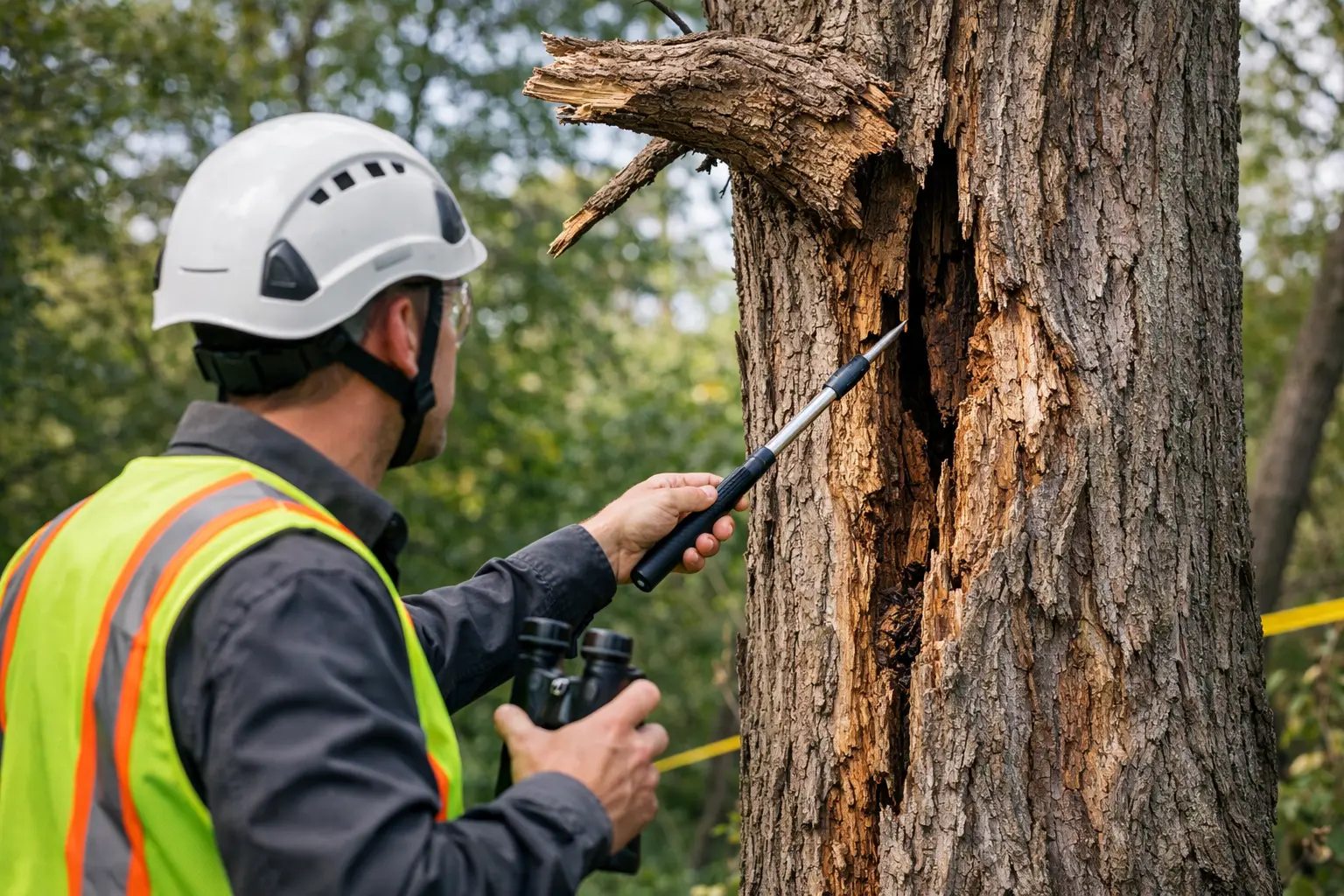
Cracks in the trunk or major limbs are among the clearest signs to take seriously. Look for fresh, pale timber exposed through the bark, splits where a branch joins the trunk, or a long vertical seam running down the stem. A crack can indicate that fibres have already separated, especially if it has appeared after wind.
Some trees naturally develop furrowed or textured bark, so not every line is a structural crack. What matters is a new opening, movement around the split, weeping sap, or a visible gap that deepens towards a major branch union. Keep people and vehicles clear of the area until an arborist has assessed it.
Dead, broken or hanging branches
Deadwood is common in mature trees and does not always mean the whole tree is unsafe. However, large dead branches over a house, footpath, driveway, outdoor seating area, school yard or public access point need managing before they fall.
Look for branches with no foliage when the rest of the tree is in leaf, peeling bark, fungus, snapped ends or a dull grey appearance. A broken branch caught in the canopy, sometimes called a hanger, is particularly hazardous because it can drop without warning. This is not a job for a pole saw from the ground. The branch may be under tension or tangled with other limbs.
Leaning that is new or getting worse
Many established trees grow with a natural lean and remain stable for decades. The concern is a lean that is recent, suddenly more pronounced, or paired with disturbed soil and exposed roots on the opposite side.
Check for a raised mound of soil, cracking ground, a gap between roots and soil, or roots lifting near the base. These symptoms can point to root plate movement. Treat a tree with a new lean after a storm as urgent, particularly if it could reach a building, road, gate or power line.
Decay, cavities and fungal growth
Decay reduces a tree’s strength from the inside out. Cavities, holes, soft or crumbly wood, and large areas of missing bark are all reasons to arrange an assessment. Fungal fruiting bodies, such as brackets or mushrooms at the trunk base, can also signal decay in roots or internal wood.
Fungus is not a verdict by itself. Some fungi live on dead material without causing major structural failure, while others are associated with significant wood decay. A qualified arborist considers the type and position of fungal growth alongside the tree’s condition, size and target area. Avoid scraping fungi away, as that removes useful evidence without fixing the underlying issue.
Weak branch unions and co-dominant stems
A strong branch attachment generally has a visible collar where the branch meets the trunk. A weaker union may have bark trapped or compressed in the join, creating a narrow V-shaped crotch rather than a broad U-shaped connection. This is known as included bark.
Trees with two or more large stems growing from the same point can be more vulnerable to splitting, especially as the stems become heavier. These are called co-dominant stems. They are not automatically dangerous, but cracks, included bark and heavy end weight can make them a priority for pruning, cabling and bracing, or more detailed risk management.
Root damage and changes around the base
Roots are the tree’s anchor system as well as its water and nutrient supply. Excavation for services, new paving, retaining walls, driveway works and changes to drainage can all damage roots. Compacted soil from parked machinery or stored materials can also affect tree health over time.
Warning signs include thinning foliage, dieback in the upper canopy, reduced leaf size, early leaf drop, mushrooms around the root zone and soil movement at the base. These symptoms may develop months or even years after construction work. If work is planned near a significant tree, seek arboricultural advice before digging begins rather than trying to solve the problem afterwards.
Canopy dieback and sudden changes in health
Dead tips, sparse foliage and branches dying back from the outer crown can indicate drought stress, pests, disease, root problems or age-related decline. While a stressed tree is not necessarily an immediate hazard, progressive dieback can lead to falling branches and reduced structural resilience.
Compare the tree with its usual seasonal appearance and nearby trees of the same species. A sudden change is more concerning than a gradual, expected seasonal shift. Take photos from the same position over several weeks if the situation is safe, as this can help show whether decline is progressing.
Symptoms that call for urgent action
Move people, pets and vehicles away from the likely fall zone and arrange professional help promptly if you see a split trunk, a branch partly detached above a target, a tree lifting at the roots, or storm damage affecting the main structure. Do not enter the area after dark to inspect it more closely.
If a tree or branch is touching power lines, keep well clear and contact the electricity network operator or emergency services where there is immediate danger. Never attempt to cut, move or use equipment near live lines. Even branches that appear clear can shift unexpectedly during removal.
For an immediate threat to life, property or access, emergency tree response should focus first on making the area safe. Final pruning, removal or cleanup can follow once the site has been stabilised.
What a professional tree assessment considers
A proper hazard assessment is more than a quick look at the canopy. An arborist examines the tree’s species, age, vitality, defects, root environment, past pruning, wind exposure and the places people or property could be affected. This produces a proportionate recommendation rather than assuming removal is always the answer.
Depending on the defect, the right response may be selective deadwood removal, weight reduction pruning, cabling and bracing, root-zone protection, monitoring, or technical removal. Pruning can reduce loading on a weak limb, but cutting too much from a stressed tree can create further problems. It depends on the defect, the tree’s capacity to respond and its location.
Some trees may also be protected by local planning controls. Before major pruning or removal, check whether consent or a formal report is required. This is particularly relevant for commercial sites, developments and properties with notable mature trees.
Keep a clear record and act before the next storm
If you manage a larger property, school, business site or rural holding, record the tree’s location, observed symptoms and the date they were noticed. Photographs taken from a safe distance are useful. A simple inspection routine after severe weather and before high-use seasons can prevent small issues from becoming emergency callouts.
Trust what you can see, but do not assume you can see everything. When a tree has a significant defect or sits close to people and property, an experienced arborist can provide the practical judgement needed to protect the site while retaining healthy trees wherever possible. Tree Technician approaches this work with safety-led techniques, qualified assessment and a clean, professional result.
www.treetechnician.co.nz