A neglected tree rarely announces a problem during business hours. It becomes urgent after a storm, when a low limb blocks vehicle access, a dead branch falls near a car park, or a tenant raises a safety concern. Commercial tree maintenance contracts replace that reactive cycle with planned, professional care that protects people, property presentation and the long-term health of your trees.
For property managers, body corporates, schools, industrial sites, retail centres and large landholdings, tree work is far more involved than general gardening. It requires careful attention to site safety, access logistics, qualified arboricultural expertise, council obligations and clear communication with everyone who uses the space. A solid, well‑structured contract helps keep all of these moving parts under control.
What commercial tree maintenance contracts should cover
The right arrangement starts with an assessment of the site, not a generic schedule. A mature avenue of trees beside public parking needs a different level of attention from young boundary planting around a warehouse. Tree species, age, condition, location, public access and seasonal weather patterns all affect what is needed and when.
A practical contract commonly includes scheduled inspections and pruning, deadwood removal, clearance from buildings and services, hedge management, green-waste removal and reporting. It can also allow for stump grinding, pest or disease observations, tree risk assessments and emergency response where required. The aim is to agree on the recurring work before minor issues become disruptive, hazardous and expensive jobs.
The scope should be clear about what is included, how frequently crews will attend, and what happens when an inspection identifies additional work. This avoids the common frustration of assuming a contractor will deal with every issue on site, only to find that a significant hazard or removal falls outside the agreed programme.
Planned maintenance versus one-off tree work
One-off tree work has its place. If a tree is storm-damaged, blocking construction access or has suddenly failed, the priority is a prompt, safe response. But isolated jobs do not create a record of changing tree condition or help a site manager plan ahead.
A maintenance contract provides continuity. The arborist gets to know the site, recurring access constraints and the trees that need closer observation. The client receives a predictable schedule and a clearer view of priorities. That does not mean every tree needs work every year. Good arboriculture avoids unnecessary pruning. Some trees may only need periodic inspection, while high-use areas may need more frequent attention.
The business case for scheduled tree care
Tree maintenance is often judged by how tidy the grounds look after a crew leaves. Presentation matters, particularly at customer-facing premises, education sites and managed residential developments. Yet the greater value is risk control.
Deadwood, poor branch unions, root-zone damage, canopy imbalance and branches growing into structures can create hazards that are not obvious from ground level. Regular inspections allow concerns to be identified early and prioritised according to their likelihood and potential consequences. This is especially useful for organisations with a duty of care to staff, visitors, residents and contractors.
Planned work also reduces disruption. Pruning can be timed around site activity, nesting considerations, seasonal growth and weather conditions. Access equipment, traffic management and work zones can be organised before the crew arrives. For a busy commercial property, that is far easier than cordoning off part of the site at short notice after a branch failure.
There is an environmental benefit as well. Correct pruning supports structure, airflow and tree vitality without stripping the canopy or leaving poor cuts. Retaining healthy mature trees can improve shade, amenity and the appearance of a developed site. Where removal is necessary, a contract can incorporate replacement planting advice or a longer-term management plan.
Building a contract around your site
The good contract will be specific enough to be useful but flexible enough to respond to real conditions as they arise. Start by identifying the areas where tree failure or overgrowth would have the greatest impact. These may include car parks, pedestrian routes, playgrounds, loading zones, building entrances, neighbouring boundaries and overhead services.
A site inventory is valuable for larger or more complex grounds. It records the key trees, their approximate location, condition and recommended actions. This gives property teams a working reference when budgets, tenancy changes or development plans affect the site. It also helps ensure important concerns are not lost when management responsibilities change hands.
Set realistic service frequencies
Frequency should follow risk and growth, not an arbitrary calendar. Fast-growing hedges near entrances may need regular trimming through the active growing season. Trees beside roads, paths or high-occupancy areas may need annual inspection. Lower-risk trees in a rear paddock may require less frequent review, unless weather events or visible decline change the picture.
A contract can be structured around seasonal visits, annual inspections or a combination of both. Canterbury conditions can be hard on trees, with wind, dry periods and sudden weather changes placing additional stress on vulnerable specimens. A qualified arborist can recommend a programme based on the site rather than over-servicing every tree.
Define safety and access responsibilities
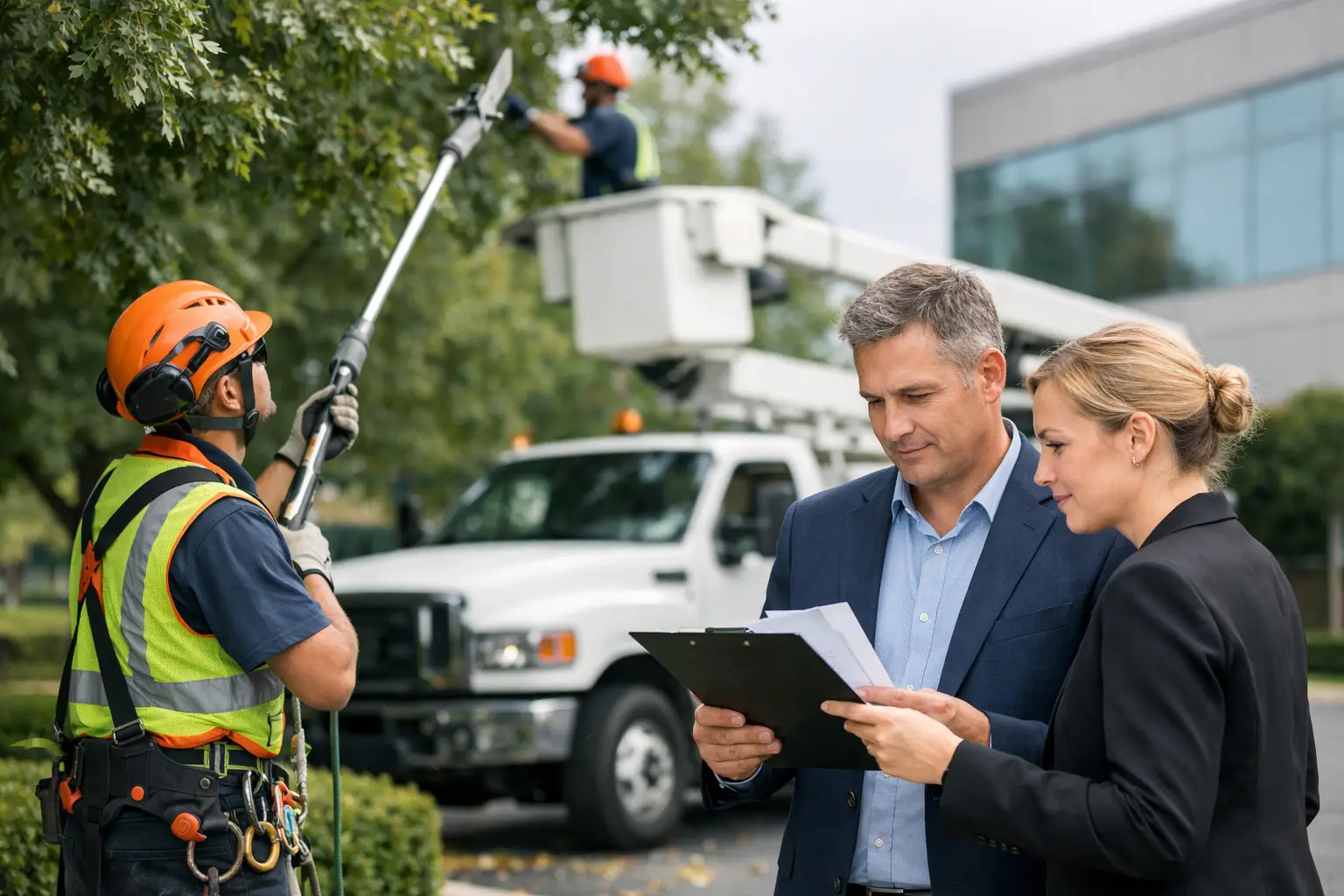
Commercial sites have moving vehicles, pedestrians, staff, contractors and members of the public. Before any work begins, the contractor should assess hazards, establish exclusion zones and use suitable equipment for the task. For elevated or technical work, this may include climbing systems, elevated work platforms, rigging and controlled lowering techniques.
The client also has a role. They may need to provide site access, notify tenants, reserve parking spaces, identify underground or overhead services and arrange traffic control where necessary. Clear responsibilities make the day run efficiently and help prevent avoidable delays.
Ask how the contractor manages health and safety documentation, crew competence, equipment maintenance and public protection. For complex sites, the ability to provide site-specific planning and communicate with facility managers is just as important as the final cut.
Include reporting that is useful, not excessive
Reports do not need to be complicated to be valuable. After a scheduled visit, a concise record can confirm the work completed, identify defects or emerging risks, note recommended actions and document any trees that require monitoring. Photos can be helpful where a property manager needs to brief an owner, committee or internal team.
For protected trees, development sites or trees with a significant hazard profile, more formal consultancy arboriculture may be required. This can include tree assessments, risk evaluations, management plans and advice around consent conditions. The level of documentation should suit the decision being made. A simple maintenance visit does not always need a lengthy report, but a tree near a building or public area may justify closer assessment.
Questions to ask before appointing an arborist
The cheapest-looking proposal can become costly if it leaves uncertainty around safety, cleanup or responsibility for follow-up work. Before committing to a contract, check that the contractor is qualified, has certified health and safety and carries appropriate insurance, has trained staff, maintained equipment and experience working on commercial sites.
It is also worth confirming how they approach pruning. Good tree care is not about cutting as much as possible. Excessive reduction can stress a tree, encourage weak regrowth and create future maintenance issues. Ask how recommendations are made, whether work will be prioritised by risk, and how the contractor handles protected trees or work near services.
Consider the finish as well. Commercial grounds need to be left clean and usable. The agreement should state how timber, chip and other green waste will be managed, whether mulch can remain on site, and how access areas will be restored after work. These details matter to tenants and visitors, even when the arboricultural work itself is excellent.
When a contract needs to change
A maintenance plan should not be set and forgotten. New construction, altered vehicle routes, tree growth, storm damage and changes in site use can all change the risk profile. A tree that was once well away from activity may become a concern when a new footpath, outdoor dining area or parking bay is installed beneath it.
Tree Technician takes a practical, grounded approach to commercial work: safety first, the right arboricultural care, and a tidy finish that makes managing your grounds easier. The most useful contracts are the ones that give your team confidence that the trees on site are being monitored, maintained and handled before they turn into tomorrow’s costly emergency.