A tree growing beside a fence can be a welcome screen, a source of shade, or the start of a difficult conversation. Boundary tree responsibility is rarely as simple as deciding whose side the branches sit on. The trunk position, the tree’s condition, local rules and the work proposed all matter. Getting those details right early helps protect people, property and neighbourly relationships.
What determines boundary tree responsibility?
The first question is not who is annoyed by the leaves or shade. It is where the tree is actually growing. A tree with its trunk entirely on one property will generally be the responsibility of that property owner, even if branches, fruit or roots extend across the boundary. If the trunk sits on, or genuinely straddles, the boundary line, responsibility and decision-making may be shared.
Looks can be misleading. Fence lines move, old fences are not always on the legal boundary, and a wide buttress root can make a trunk appear to be in a different place from where it started. Before arranging major pruning or removal, check the property plan or survey information. For a large, valuable or disputed tree, confirming the legal boundary is usually money well spent.
Ownership is only one part of the picture. A tree owner has a duty to manage foreseeable risks from their tree. If a dead limb, split stem or unstable lean could cause damage or injury, ignoring it because the hazard overhangs next door is not a sensible option. Equally, a neighbour should not carry out work on a tree they do not own without appropriate consent.
Branches and roots crossing the boundary
Overhanging growth is where most boundary tree issues begin. In many situations, an adjoining owner may be able to trim encroaching branches or roots back to the boundary, but that does not give them free rein to damage the tree. The exact rights and obligations can depend on local law, the circumstances and whether the tree is protected.
The practical rule is straightforward: do not cut first and ask questions later. Heavy reduction on one side can leave a tree unbalanced, expose it to sun damage, create large decay-prone wounds or trigger failure in high winds. Root cutting can be even more serious. Severing structural roots may destabilise a mature tree, while cutting fine roots can affect its health over time.
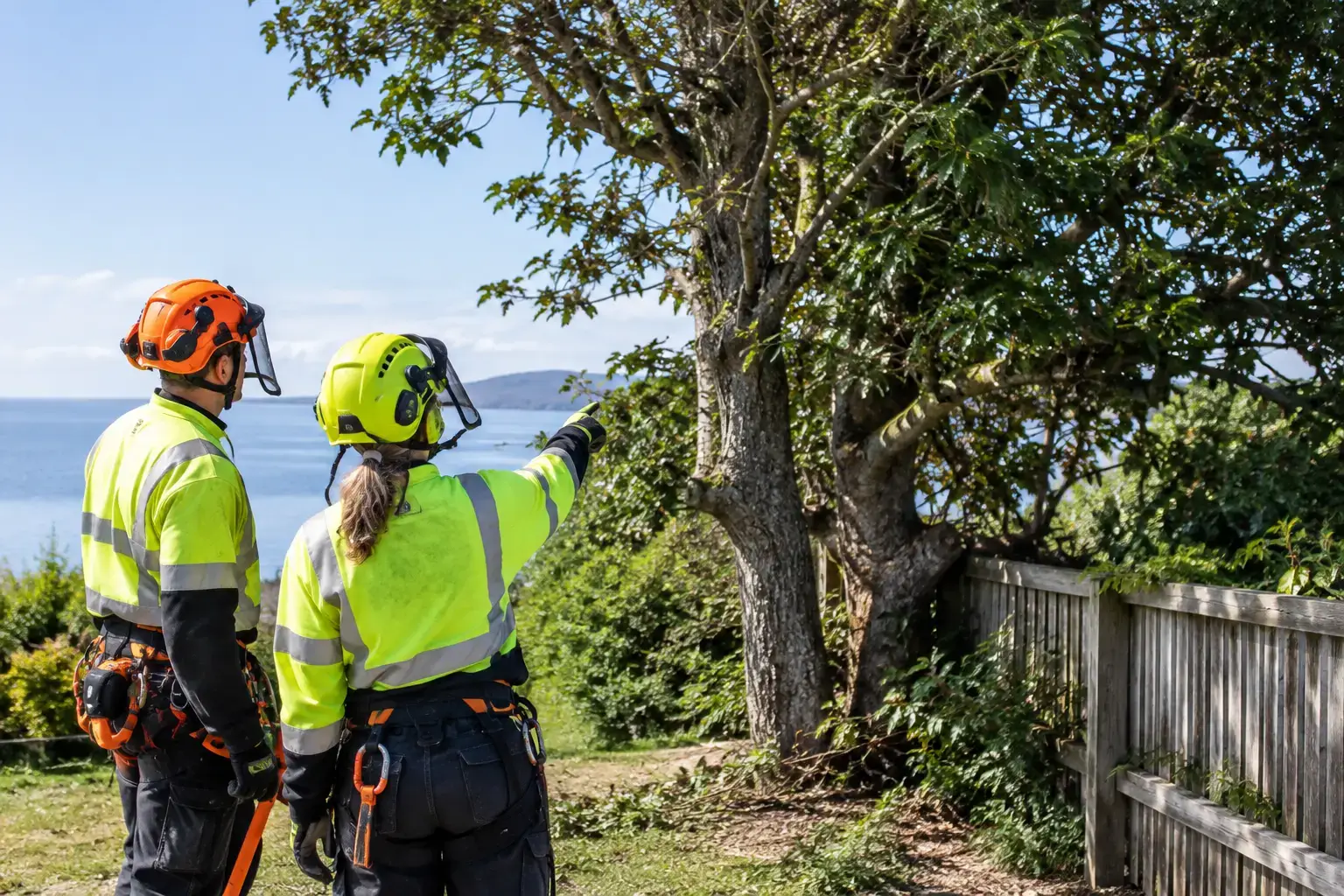
Talk with the owner before work begins and agree on the intended result. A qualified arborist can assess how much pruning the species and structure can tolerate, specify suitable cuts, and explain whether staged work is safer. This is especially useful where a tree has grown over a roof, driveway, power line, shed or shared accessway.
If removed material belongs to the neighbour or is likely to be contentious, clarify who will take it away rather than tossing it back over the fence. A clean site and a clear agreement prevent a small job becoming an unnecessary dispute.
When consent matters
Consent should be explicit for substantial pruning, tree removal, access across a neighbouring property or work involving shared trees. A quick conversation is often enough for routine maintenance, but written confirmation is a sensible safeguard when the tree is large, work is complex or several owners are involved.
For commercial properties, body corporates, schools, rental homes and development sites, record the decision and retain the arborist’s recommendation. It provides a useful trail if questions arise later about safety, scope or tree condition.
Do not overlook protected-tree and council requirements
Being responsible for a tree does not automatically mean you can prune or remove it whenever you choose. Councils may have rules for notable, heritage, scheduled or protected trees. There may also be requirements relating to subdivision conditions, development consent, waterways, reserves, road corridors or vegetation clearance.
Rules differ between councils and can change, so check before booking work. A professional arboricultural assessment can identify whether a tree needs a formal report, management plan or consent application. That is particularly worthwhile where a development footprint, new driveway or building work could affect the root zone.
Even an otherwise straightforward boundary tree can be subject to restrictions. The right approach is to confirm the tree’s status, identify the work needed, and obtain approvals before machinery arrives on site. This avoids delays, avoidable costs and damage to trees that may be able to be retained safely.
Hazard trees need a faster, evidence-based response
A neighbour disagreement should never delay action on an immediate hazard. Following a storm, look for hanging limbs, fresh cracks, lifted soil around the base, a sudden lean, broken leaders, cavities or branches resting on structures. Keep people, pets and vehicles away from the affected area.
Photographs can help document what has happened, but do not climb the tree, use a ladder near unstable limbs or attempt to pull damaged branches down with a vehicle. Storm-damaged trees can be under tension and behave unpredictably.
Contact the owner straight away where possible. If there is a threat to power lines, keep well clear and contact the relevant network operator or emergency service as appropriate. For other urgent risks, an experienced emergency tree team can assess the situation, make the area safe and remove dangerous material using the right equipment and controls.
A written assessment is valuable after the immediate danger has passed. It can explain the likely cause of failure, identify remaining defects and recommend monitoring, pruning, cabling and bracing, or removal. That gives owners and managers a practical basis for the next decision rather than relying on assumptions.
A sensible process for neighbours and property managers
Most boundary tree matters are resolved well before they become formal disputes. Start with a respectful conversation focused on the issue, not blame. Explain what you have noticed, whether it is blocked light, roof contact, root pressure, falling debris or a safety concern. Share photographs if they make the problem clearer.
Next, arrange an inspection where the stakes are high. An arborist can distinguish between normal leaf drop and a genuine defect, or between a manageable branch and a structural issue requiring urgent work. Their advice should consider the tree’s species, age, health, past pruning, targets beneath it and the likely effect of proposed work.
Then agree on the scope. Be specific about access, timing, pruning limits, site protection, clean-up and who will communicate with council if permissions are required. If the tree is shared, make sure all relevant owners understand the plan. A vague agreement such as “cut it back” leaves too much room for disappointment.
Finally, use a competent, properly equipped contractor. Tree work near homes, fences and occupied premises carries real risk. Professional crews plan the drop zone, protect gardens and buildings, use suitable machinery, and leave the site tidy. For managed properties, ask for documentation that supports safe contractor selection and confirms the recommended work.
Why poor pruning creates bigger problems
It can be tempting to reduce only the boundary side as hard as possible. That may deliver a quick visual result, but it can also compromise the tree and increase future maintenance. Large stubs, topping cuts and indiscriminate lopping often produce weak, fast regrowth. The tree can become taller, denser and more prone to failure than it was before.
Good pruning is selective. It removes deadwood, reduces weight where the structure supports it, clears buildings and services where needed, and retains a natural, balanced form. Sometimes the honest recommendation is that pruning will not solve the underlying problem. A declining tree, one planted too close to a building, or one with major root damage may need removal and a better replacement choice.
That is not a one-size-fits-all decision. Mature trees offer shade, habitat, shelter and character, so retention is often worth considering. But retention needs to be compatible with safety, the available space and realistic ongoing maintenance.
Get clear advice before the first cut
Boundary tree responsibility works best when everyone deals with the same facts. Confirm the boundary, check for protection requirements, discuss access and consent, and have the tree assessed before major work begins. That approach protects the tree where it can be retained, while dealing decisively with genuine hazards.
For Canterbury property owners and managers, practical arboricultural advice can turn a stressful fence-line issue into a safe, clearly planned job. www.treetechnician.co.nz