A mature tree shading a car park can be a real asset – until a failed limb damages a vehicle, blocks an entry or puts people at risk. This commercial grounds tree care guide is for property managers, facilities teams and site owners who need their trees to look good, stay healthy and remain manageable without creating unnecessary disruption.
Commercial tree care is not simply a matter of cutting back growth when it starts to look untidy. Trees sit alongside buildings, power services, pedestrian areas, vehicle accessways, signage and neighbouring properties. Managing them properly means making sound decisions before small maintenance issues become safety, compliance or access problems.
Start with a clear picture of your tree assets
The most useful first step is a site-wide tree assessment. This does not always need to be a lengthy report, but it should identify what trees are present, where they are located, their general condition and any obvious risks. Large, mature or high-use sites benefit from a formal tree inventory and management plan, particularly where trees are close to public areas or essential infrastructure.
Record each tree or group of trees by location, species, approximate size and condition. Note overhanging branches above car parks, footpaths, loading areas, playgrounds, roofs and neighbouring boundaries. Also note past failures, fungal growth, cavities, deadwood, soil compaction, root damage and conflicts with lights, signs or services.
A good assessment separates urgent defects from routine work. A dead branch above a busy entrance needs prompt attention. A tree that is simply becoming dense may be suitable for planned pruning during the right season. Treating every tree issue as urgent can stretch budgets, while putting off genuine hazards can cost far more later.
Risk depends on both the tree and the target
A defect alone does not always make a tree high risk. A dead branch over an unused corner of a large site is different from the same branch over a staff entrance. Arborists consider the likelihood of failure, the size of the part that could fail and what is likely to be beneath it.
This is why regular inspections matter after strong winds, prolonged dry periods, heavy rain or construction activity. Canterbury conditions can be tough on trees, especially where exposed sites, compacted ground and changing moisture levels are involved. Storm damage is often obvious, but root disturbance and internal decay are not always visible from the ground.
Build a commercial grounds tree care programme
Reactive call-outs have their place, particularly after a storm. They should not be the foundation of your maintenance approach. A planned programme allows work to be scheduled around tenants, customers, school hours, deliveries, seasonal growth and site access.
For many commercial properties, an annual inspection paired with programmed pruning is a sensible baseline. High-traffic sites, aged trees, fast-growing species or sites with a history of failures may need more frequent checks. Newly planted trees also need regular monitoring while they establish.
Your programme should cover practical tasks such as crown cleaning, selective pruning, hedge maintenance, mulch renewal, pest and disease observations, storm checks and removal of trees that are declining beyond reasonable retention. It should also state who is responsible for authorising work and where records will be kept.
Keep records of inspections, recommendations, approvals and completed work. This creates a useful maintenance history and helps demonstrate that hazards have been managed responsibly. It also prevents the common problem of the same issue being noted year after year without a clear decision or outcome.
Prune for structure, clearance and tree health
Pruning has a purpose beyond making a tree look neat. The right cuts can remove deadwood, improve clearance, reduce weight on selected limbs and encourage better structure. The wrong cuts can cause decay, stimulate weak regrowth or leave a tree stressed and unattractive.
Avoid blanket topping or excessive reduction to solve a clearance issue. It may offer a quick visual result, but it can create dense, weakly attached shoots and increase ongoing maintenance. In many cases, selective pruning or targeted reduction achieves the required clearance while preserving the tree’s form and health.
The timing of pruning depends on the species, its condition and the scope of work. Some trees tolerate seasonal pruning well, while others are more vulnerable to stress, pests or disease at certain times of year. A qualified arborist can recommend a practical timing window rather than applying one rule to every tree on site.
Plan work around people, vehicles and operations
Commercial sites rarely have the luxury of being empty. Tree work may require vehicle exclusion zones, traffic management, temporary footpath closures, access for chippers or elevated work platforms, and clear communication with occupants.
Before work begins, agree on the scope, access route, work hours and cleanup standard. Let tenants or staff know if parking spaces, entrances or loading areas will be affected. For jobs near busy public areas, work may need to be completed outside peak hours or broken into stages to keep disruption low.
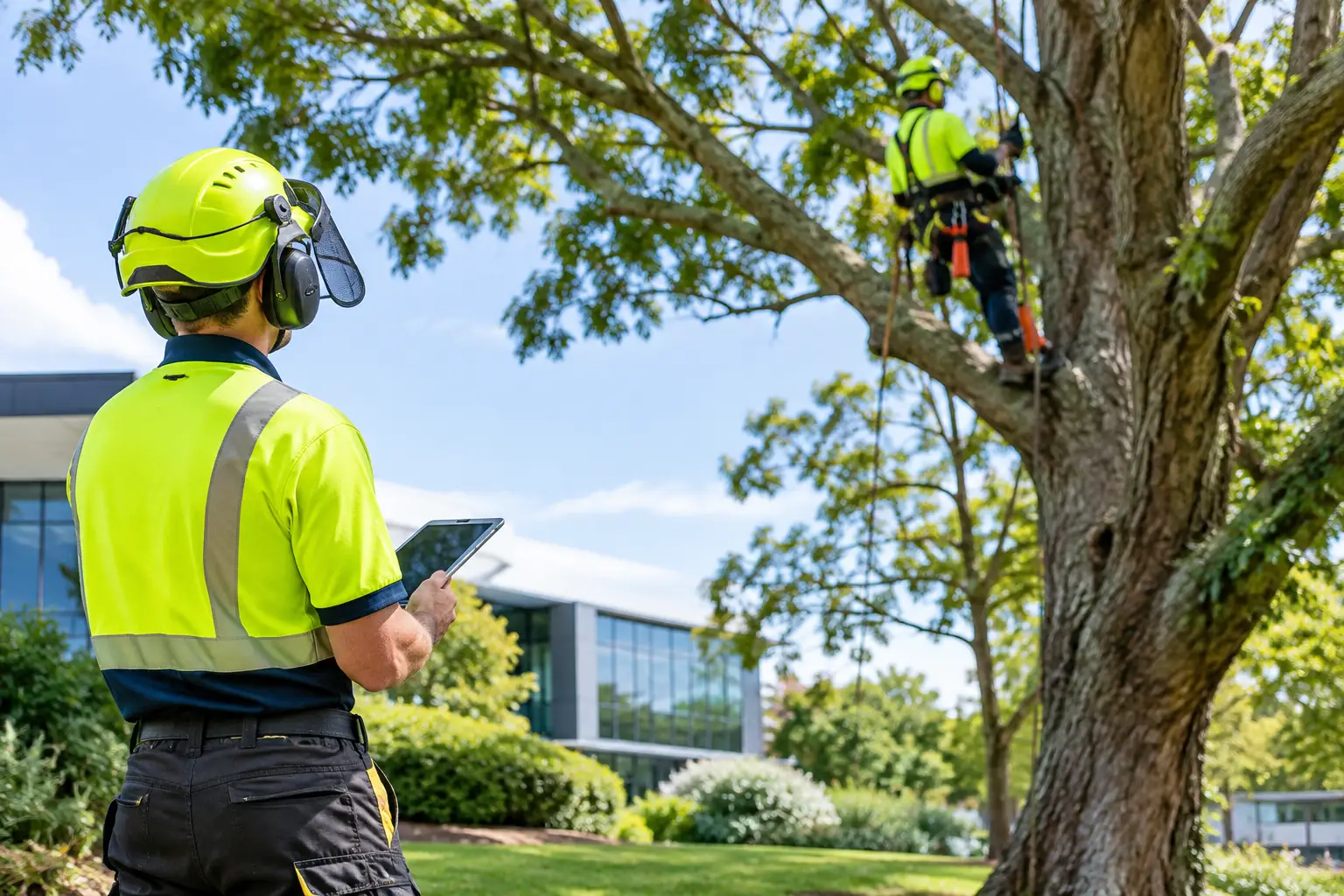
A professional crew should assess the work area each day, establish exclusion zones and use maintained equipment suited to the job. Climbing, rigging and machinery work all carry risks, particularly around buildings and traffic. Health and safety is not paperwork added after the fact – it is how the job is planned and carried out from the start.
Check rules before pruning, removing or developing
Not every tree can be pruned or removed without checking local requirements. Protected trees, trees within particular zones and trees affected by development conditions may need consent or a supporting arboricultural report. A tree’s size, species and location can all influence what work is permitted.
This is especially relevant when planning land clearance, building works, new driveways or service trenches. Roots often extend well beyond the canopy, so excavation or compaction can damage a retained tree even when no branches are removed. Early arboricultural input helps identify protection measures, workable construction setbacks and trees that may need to be removed before works begin.
Do not assume a tree is safe to retain because it appears healthy, or that it can be removed because it sits on private land. Checking requirements early protects project timelines and avoids avoidable rework.
Know when removal or support is the better option
Retaining established trees is often worthwhile for shade, visual amenity, screening and environmental value. But retention is not always the responsible choice. A tree with significant structural defects, advanced decline, major root damage or repeated branch failure may present an ongoing risk that pruning cannot reasonably resolve.
Removal can also be appropriate where a tree is incompatible with a planned use of the site, such as a new accessway or essential building works. The decision should be based on condition, risk, site needs and any regulatory requirements – not appearance alone.
Some trees can be retained with cabling or bracing where they have a structural weakness but remain suitable for the site. These systems require proper installation and ongoing inspection. They are not a permanent fix for every defect, and they should never replace a realistic risk assessment.
Choose a contractor who can advise as well as carry out the work
Commercial grounds need more than a crew with chainsaws. Look for a contractor with arboricultural knowledge, appropriate insurance, documented safety systems, capable equipment and experience working around active premises. The ability to provide formal assessments and management plans is valuable when decisions need to be justified to owners, councils, insurers or project teams.
Tree Technician has worked across Canterbury since 1991, combining practical tree work with consultancy arboriculture, hazard management and a safety-first approach. For commercial sites, that means clear recommendations, reliable scheduling, careful site control and a tidy result once the work is complete.
The best time to organise tree care is before a limb falls, a tenant complains or a construction programme is already underway. A clear plan gives you safer grounds, healthier trees and fewer urgent decisions when the weather turns.
www.treetechnician.co.nz