A mature tree can look perfectly healthy from the driveway while a hidden defect is developing below ground or high in the canopy. After heavy rain, strong winds or a long dry spell, that defect can become a fallen limb over a roof, car park, footpath or fence. A professional tree risk assessment gives property owners a clear, practical picture of what needs attention and what can be safely retained.
The aim is not to remove every tree that has a flaw. Good arboriculture balances safety with the value trees bring to a property – shade, privacy, habitat, shelter and visual appeal. The right outcome may be selective pruning, monitoring, cabling and bracing, soil improvement, removal, or simply no work at all.
What a tree risk assessment looks at
Tree risk is more than whether a tree appears likely to fall over. An arborist considers the condition of the whole tree, the site around it and the potential consequences if a branch or stem fails.
The inspection begins at ground level. Root plate movement, fungal fruiting bodies, compacted soil, poor drainage, exposed roots, recent excavation and changes in ground level can all affect stability. A tree growing beside a new driveway, retaining wall or building site may have had roots damaged without the impact being immediately obvious above ground.
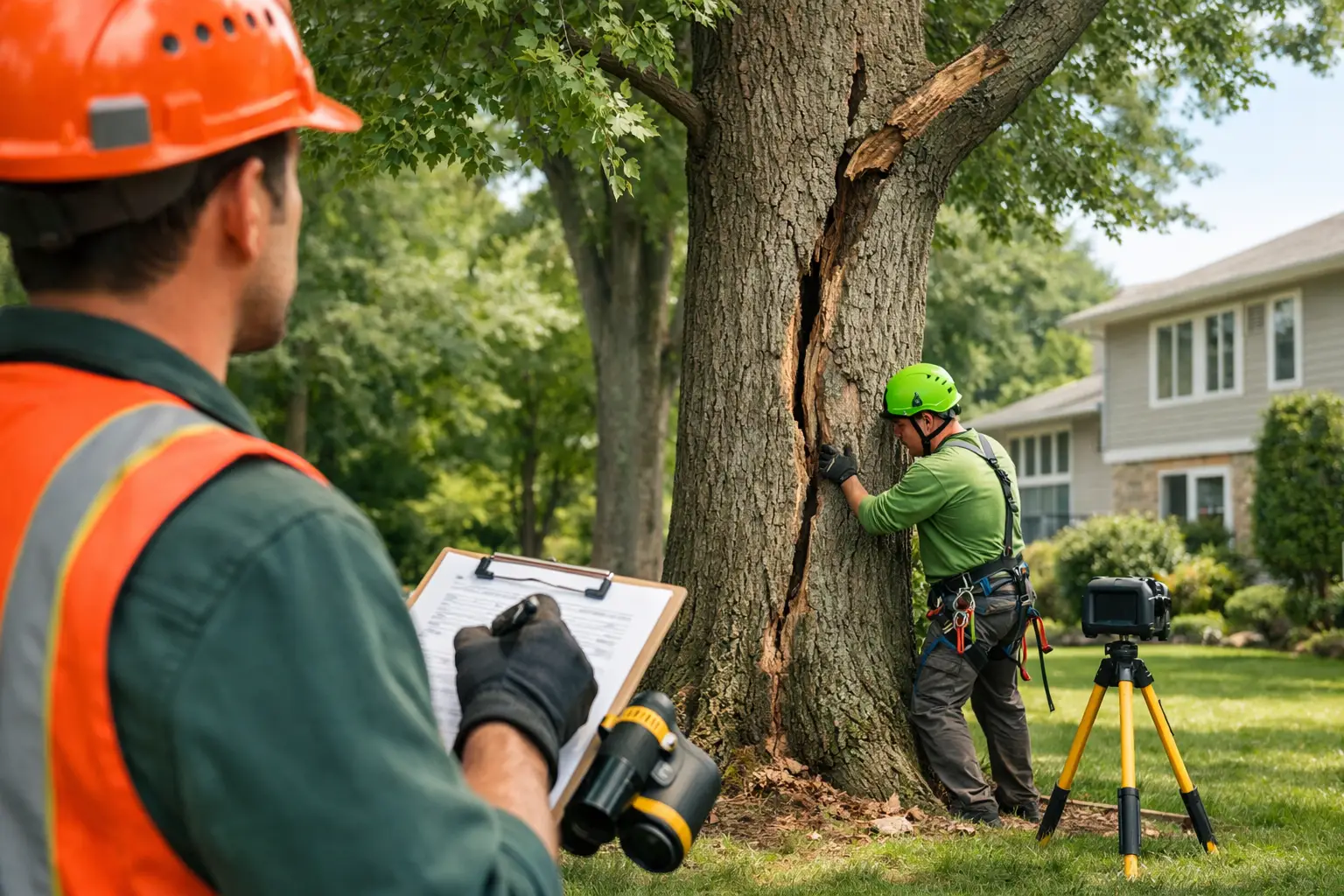
The trunk and main branch structure are then examined for cracks, cavities, weak unions, decay, old pruning wounds, bark damage and included bark. Included bark occurs where two stems grow tightly together with bark trapped between them, creating a connection that may be weaker than it looks. In the canopy, an assessor looks for deadwood, broken limbs, excessive end weight, poor branch attachments, pest or disease symptoms, and uneven growth that suggests a structural issue.
Just as importantly, the assessment considers what sits within the tree’s fall zone. A small dead branch over a garden bed carries very different consequences from a large limb over a bedroom, playground, access road or busy commercial entrance. Risk is shaped by both the likelihood of failure and the likelihood of someone or something being there when it happens.
When should you arrange a tree risk assessment?
A formal assessment is sensible whenever there is uncertainty about a tree’s condition or its potential to affect people and property. For homeowners, this often follows a storm, a visible change in the tree, or plans to build near established trees. For property managers and landholders, assessments can support routine maintenance programmes, tenant safety, asset management and development planning.
Warning signs worth acting on include new cracks in major limbs, a trunk that is splitting, mushrooms or brackets growing near the base, branches dying back in one area of the canopy, soil lifting around the trunk, fresh lean, hanging limbs, or a tree that has lost major branches in wind. These signs do not always mean immediate removal is required, but they should not be ignored.
An assessment is also useful before construction, trenching, driveway work or land clearing. Tree roots often extend well beyond the canopy edge, and works that disturb them can compromise a tree months or years later. Identifying retained trees and setting practical protection measures before machinery arrives is usually far easier than dealing with decline afterwards.
For commercial sites, schools, body corporates and rural properties, scheduled inspections are a sensible way to manage trees in high-use areas. The appropriate interval depends on tree age, species, site exposure, known defects and how often people use the area. A mature specimen beside a public accessway deserves closer attention than a young tree in a low-use paddock.
How arborists determine the level of risk
A sound assessment is evidence-based, not a quick judgement made from the cab of a ute. The arborist records tree details, site conditions, defects, targets and recommended actions. Depending on the assignment, this may be a straightforward visual inspection or a formal written report for a property file, insurer, consent process or management plan.
The key questions are practical. What part of the tree could fail? How likely is failure within a defined period? What would it strike? And what can reasonably be done to reduce the risk? This approach prevents two common mistakes: overreacting to a manageable defect and underestimating a serious one.
Some defects are visible, while others need closer investigation. Sounding tools, decay detection equipment, aerial inspection or further root-zone investigation may be recommended where the likely consequence is high and the initial findings are unclear. There are limits to any assessment: trees are living structures, weather changes quickly, and no inspection can guarantee that a failure will never occur. A good report explains this uncertainty plainly while setting out proportionate next steps.
Recommendations should fit the tree and the site
Removal is sometimes the safest option, particularly where a tree has major structural decline, extensive root damage or a defect that cannot be managed around a high-value target. Yet removal is not the default answer.
Targeted pruning can reduce leverage on long limbs, remove deadwood and improve clearance from buildings or access routes. Cabling and bracing may help support selected stems where the tree is otherwise healthy and worth retaining, although these systems need installation by trained professionals and ongoing inspection. Moving a seating area, restricting access during severe weather or altering how an area is used may also reduce exposure without changing the tree itself.
Monitoring is appropriate for some lower-risk defects. It should be specific: what is being monitored, who will check it, what changes trigger action, and when the tree will be reassessed. “Keep an eye on it” is not a management plan when a large tree stands near a home or public space.
Where a tree is protected by local planning controls or covered by a development condition, an assessment can document its condition and help guide the correct approval pathway. Unauthorised pruning or removal can create avoidable delays and compliance issues. Early advice helps property owners plan work properly, especially when safety concerns and tree-retention requirements need to be weighed together.
What to do if a tree becomes an urgent hazard
If a branch has fallen, a tree is touching powerlines, the trunk is splitting, or the root plate is lifting after a storm, keep people away and treat the area as unsafe. Do not climb the tree, attempt to pull a hanging branch down, or use a chainsaw from a ladder. A damaged tree can shift without warning, and powerline hazards require the relevant network operator or an appropriately authorised contractor.
Take clear photos from a safe distance if you can do so without entering the fall zone. This can help an arborist understand the immediate issue before arriving. Emergency work should focus first on making the site safe, then on deciding whether further pruning, removal or assessment is needed once conditions settle.
Choose advice that leads to practical action
The value of a tree risk assessment is in the quality of the judgement behind it and the clarity of the recommendations that follow. Look for an arboricultural provider that can assess the tree, explain the risk in plain language and carry out the agreed work safely if action is required. For complex sites, documentation, traffic or pedestrian management, suitable equipment and a disciplined safety process matter just as much as technical knowledge.
Tree Technician brings hands-on arboricultural experience to assessments across Canterbury, helping homeowners, land managers and commercial clients make sensible decisions before a minor concern becomes an expensive or dangerous problem.
If a tree has changed, has been affected by weather, or sits close to an area where people live, work or pass through, arranging an assessment is a practical step towards protecting both the property and the tree.